Many of you involved with Washington Bikes know Andy Goulding. Andy is an ardent supporter of and a tireless volunteer for this organization. He’s also the husband of our Executive Director Barbara Culp.Hey, mom… No training wheels!
Many of you involved with Washington Bikes know Andy Goulding. Andy is an ardent supporter of and a tireless volunteer for this organization. He’s also the husband of our Executive Director Barbara Culp.Legislative Update: Time runs out on 20 mph bill
- Traffic School Safety Education bill, HB 1129 awaits the Governor’s signature.
- The Complete Streets bill SHB 1071 was passed in the Senate, but amended. It now just needs House concurrence then goes to the Governor for her signature.
- HB 1700, which addresses transportation project design in a way that could greatly benefit bicycle and pedestrian facilities, is currently in Senate Rules. Once pulled from Rules, it goes for a Senate floor vote. It has already passed in the House.
- Vulnerable Users, SB 5326 has passed the House which amended the bill. Next up is Senate concurrence, and if that occurs, then it is off to the Governor.
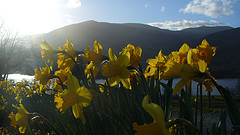
April showers bring the Daffodil Classic
![]() |
| flickr/Mr Ush |
It’s spring, we’re on daylight savings time, and you’re probably itching to ride your bike more. How about signing up for the Daffodil Classic on April 10?
Create a Bicycle Friendly Wenatchee
Bicycle friendly communities don’t just happen. It takes public planning, citizen support, political will, funding and engineering.
The Wenatchee Valley Transportation Council is developing a Metropolitan Bicycle Master Plan for the communities of Wenatchee, East Wenatchee, Rock Island and Sunnyslope. They are seeking input from area cyclists to identify how and where people currently ride, as well as where they would like to ride but can’t for whatever reason. This information will be used to create a regional bicycle network.
If you are a Wenatchee Valley bike rider, please take a few minutes to complete the online bike survey. Your participation and support of the Bicycle Master Plan can improve the bikeability of the region.
The “Mutual Responsibilities” Bill—What’s Up?
Membership Matters: Fix A Flat, Grow The Alliance
- You are riding along and see a cyclist stopped on the side of the road. Perhaps the bike is upside down. (Why is it that roadside repairs for the uninitiated often involve upside down bikes?) Perhaps the rider has a sheepish “what now?” look. Perhaps there is even a gaggle of riders engaged in what appears to be a corporate team building experience centered on a surprisingly quiet bike. You offer help and get an enthusiastic acceptance. You fix a flat, boot a tire with a bar wrapper, or pull out a multi-tool, and soon they are on their way. They are thankful.
- People at your kid’s bus stop know you as “The Mom Who Rides All The Time,” and they ask you to teach their kid to ride. You work your magic in a few trips to the park, and their kid wobbles off for the first time filled with pride and excitement. Ice cream and pictures may even be involved. They are thankful.
- A casual riding buddy adopts your garage as his favorite bike shop. It is convenient and affordable! You teach him the mysteries of handlebar tape wrapping. They are thankful.
- A neighbor stops by with a kid’s bike they picked up at a garage sale. You chip in some parts and teach the kid basic maintenance as you fix it up. They are thankful.
- You pass your daughter’s outgrown bike to the next kid in line. But first, you take off the pink streamers and find a Spongebob bell. Oh, and here’s a helmet you might want too. They are thankful.
- You talk a friend through his first century. They are amazed to learn they should probably eat and drink on all-day rides. “Chamois cream” may even be dropped into the conversation. They are thankful.
Biking Investments Yield Health Care Savings
![]() |
| ped-bikeimages.org/LSandt |
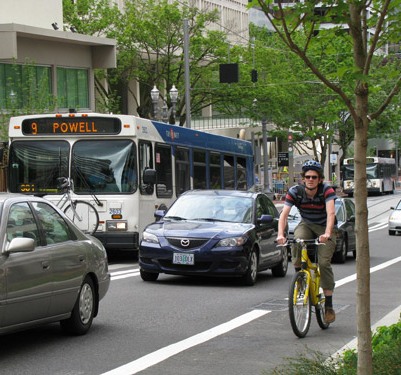
Many of us are drawn to bicycling because it’s fun and healthy. Now there’s a study that shows a community can reduce its health care costs by investing in bicycle infrastructure. We need only look south of us to Portland.
Swiss epidemiologist Thomas Gotschi selected Portland, Oregon as the subject for his paper “Costs and Benefits of Bicycling Investments in Portland, Oregon,” published in the Journal of Physical Activity & Health. His paper provides the first cost benefit analysis of an urban bicycle network in the US. Gotschi’s analysis was made possible because of Portland’s nearly 20 years of bike investments and growth in the number of people who bike, and by the long-term data analyzing the impact of their investments.
In short, Gotschi concludes that Portland will see a savings in health care costs due to its investments in bicycle infrastructure– – possibly in excess of $500 million over 40 years.
Furthermore, Gotschi’s analysis shows that you don’t have to invest in world-class facilities to reap the benefits. Even basic investments in bicycling can lead to an increase in the number of people who bike and a decrease in health care costs over time.
Isn’t this the kind of cost efficient investment all of our communities should be making?
Recap: 11th annual National Bike Summit
Eight hundred bicycling and walking advocates gathered in the nation’s capital in early March for the 11th annual National Bike Summit hosted by the League of American Bicyclists. Our purpose: deliver the message that biking and walking are economical, efficient, and clean transportation options.
As Congress debates the future of transportation policies and programs funding levels, bicycle advocates anticipate proposals to eliminate or dramatically change the primary sources for bicycling, walking and trail programs. Representatives from Washington Bikes, Cascade Bicycle Club, the Evergreen Mountain Bike Alliance, REI, Raleigh and Bike Lid met with the Washington representatives and senators asking for support of the popular and effective Transportation Enhancements, Safe Routes to School and Recreational Trails programs.
In every office we delivered the message that even in tough economic times, we must invest in solutions that solve multiple problems like biking and walking which improve safety, health and air quality and reduce our dependence on foreign oil. The outcomes of this advocacy effort will play out over the coming weeks and months. Watch for action alerts to save these important programs.
Notable Quotes:
US Secretary of Transportation, Ray LaHood, “It’s critically important to make communities that are cycle-friendly, and it takes all 800 of you in this room to build the political leadership to create those communities.”
Congressman Earl Blumenauer (D-OR) to his fellow Congressman, “Don’t cut what you haven’t visited or experienced!”
Janette Sadik-Khan, New York City Commissioner of Transportation, “In five years, New York City has transformed itself with 250 miles of bike lanes on city streets, protected bike lanes, bus rapid transit, bike parking in buildings AND a significant decrease in traffic fatalities = the lowest in 100 years!”
Big Announcement
The National Association of City Transportation Officials unveiled its guidance for cities seeking to improve bicycle transportation in places where competing demands for the use of right of way present unique circumstances. Check it out: Urban Bikeway Design Guide.
Happy Experience
Riding the Capitol Bike Share bike to the conference. It was a big red comfort ride. It was a blast and super-easy to use. I highly recommend it.
Inaugural award
University of Washington won a League of American Bicyclists inaugural bicycle friendly university silver award.
Hub & Spoke: next up Mount Vernon
The Bicycle Alliance is hitting the road again with its Hub and Spoke tour. This Thursday we will be in Mt. Vernon and we’re inviting area cyclists to meet up with us for some networking and discussion of bicycle issues. We’ll have an update on our legislative priorities and current projects, including our work on the US Bicycle Route System (USBRS) in Washington State. Please join us!
Let’s Lawyer Up!
![]() |
| The Missing Link (Seattle Times photo) |
But things could be worse.
![]() |
| S.F. Mayor Gavin Newsom prepares to paint a long-awaited bike lane (The Bay Citizen, San Francisco) |
|
The Prospect Park West cycle track (Park Slope Neighbors website)
Litigation notwithstanding, the new cycle track enjoys the support of 70 percent of the neighborhood’s residents and about half of those who live along the affected street. And according to the Times, a spokesman for the New York transportation department noted that since the track was installed “speeding is down dramatically, crashes are down, injuries are down, and bike ridership has doubled on weekends and tripled on weekdays.”
|
The mere fact that bike-facility opponents are motivated to litigate shows the depth of opposition that remains toward cycling in America. Baffling as it may be to regular cyclists, some part of the American public seems to perceive bicycling as a threatening proposition, bad for business and for transportation. There seems to be a widespread belief that the roads belong exclusively to cars, and that urban transport is a “zero-sum” game: if the cyclists “win,” then cars “lose.” It’s not that way, of course. Adding bicycles to the transportation mix can actually help decrease traffic congestion and increase overall mobility, as the experience of Copenhagen has demonstrated.