Let’s Lawyer Up!

Opponents of bicycle facilities have turned to the courts. The litigation isn’t likely to stop until cycling advocates win in the court of public opinion.

Baseball, it seems, is no longer the National Pastime. No, America’s favorite activity now appears to be the filing of lawsuits. And lately those lawsuits are being used as a weapon to stop the construction of cycling facilities, or remove the facilities that do exist.
Litigation is not an inherently bad thing. In fact, it’s sometimes a necessary thing (The lawsuit brought against the tobacco industry by a number of state attorneys general comes to mind). Nonetheless, litigation is always frustrating, costly and time-consuming; ramps up the emotional ante and creates an adversarial mindset; and delays resolution of the issue at hand.  
In the case of cycle-facility litigation, in fact, lawsuits can serve to postpone—sometimes for years—the construction of needed infrastructure.   But even more disturbing is what such litigation says about the negative perceptions toward cycling that persist in the United States, and about the cycling community’s limited success in combating it.
Witness a tale of three lawsuits in three cities.
The first, familiar to Puget-Sound area cyclists, is the litigation that’s delayed completion of the last one-and-a-half mile section of the Burke-Gilman Trail in Seattle’s Ballard neighborhood—the trail’s so-called “missing link.”
The bulk of the 15-mile Burke-Gilman was finished in 1978, with short additional sections built since then.  When the “missing link” is complete, cyclists will be able to travel from Seattle’s Shilshole Marina to Issaquah without ever having to ride on the street.
But according to the Pacific Northwest magazine, the Ballard segment, which would pass through an industrial neighborhood, has been mired in controversy since at least 1996. After the city finally decided on an alignment for the section in 2003, some local businesses objected, then sued, claiming that the trail would harm their industrial activities and present a safety hazard. (Editorial comment: I’m not sure how anything could be less safe than the status quo, which, as the Pacific Northwest article noted, involves cycling along a street “with the shoulder the width of a laptop and 36-ton cement trucks bearing down on you.”)
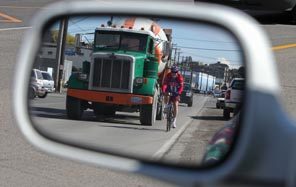
The Missing Link (Seattle Times photo)

The city won most of that lawsuit, although a judge did order an environmental review for one section of the missing link before construction could proceed.  Seattle’s transportation department (SDOT) finished that review last month, concluding that the trail would have no significant impact.
This would seem to have been the end of the delays—until a group of businesses appealed the transportation department’s conclusions to the city hearing examiner. One can presume that if the hearing examiner rules in the city’s favor, it’s off to court again to appeal the hearing examiner’s decision.  And on it will go.
So the missing link, which the city says it has the money to build and would have started building in 2009 but for the lawsuit, remains in limbo 33 years after the bulk of the trail was constructed.

But things could be worse.

In San Francisco, a lawsuit brought by gadfly and frequent cycling critic Rob Anderson put that city’s bike-lane plan on hold, at least in part, for four years.  Anderson, who shares his thoughts on the “war on cars” on his District 5 Diary blog, claimed that the City should have conducted an environmental review before proceeding—a claim not unlike that made by the plaintiffs in Seattle’s “missing link” lawsuit.
A court agreed with Anderson, so the City did the review, at a cost of $2.2 million.  The result? No changes had to be made to the plan as originally proposed.
As a result, a superior court judge last August lifted the injunction that had blocked the plan, and the San Francisco mayor Gavin Newsom finally got to lay a ceremonial strip of paint on one of the contested bike lanes.
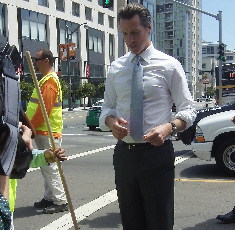
S.F. Mayor Gavin Newsom prepares to paint a long-awaited bike lane (The Bay Citizen, San Francisco)

Finally, New York City’s plans to make the city safer and more pleasant for pedestrians and bicyclists are under serious attack, as is the city transportation commissioner who is making it happen.
Mayor Michael Bloomberg had set out an ambitious agenda for changing New York’s transportation balance. To help bring that about he hired Janette Sadik-Kahn as the city’s transportation chief.
A recent New York Times profile noted that Sadik-Kahn, who is lauded as visionary by some but criticized as high-handed by others, has made huge changes, nearly doubling the miles of bike lanes in the city, creating separated European-style cycle tracks, introducing “rapid-transit” buses that use dedicated lanes, and turning once car-clogged Times Square into a pedestrian plaza. During her tenure bicycle ridership in New York has doubled and fewer people have been killed in traffic accidents in the city than at any other time during the last 100 years.
But as elsewhere, the backlash has grown. One tabloid gossip columnist has taken to calling Sadik-Kahn the “wacko-nutso bike commissioner.”  Even the New Yorker magazine’s John Cassidy, normally a sober commentator on financial issues,  has said that “it’s time to call a halt to Sadik-Kahn and her faceless road swipers.” Cassidy criticized the Bloomberg bike-lane plans as “a classic case of regulatory capture by a small faddist minority intent on foisting its bipedalist views on a disinterested or actively-reluctant populace.”  (Whew!) 
To cap it off, a group of well-connected Brooklyn residents recently filed suit against the city to force removal of a bicycle track along Prospect Park West, claiming among other things that the city had ignored required environmental review. While the lawsuit focuses on the Prospect Park bike track, the New York Times has noted that it also “incorporates criticism of the administration’s overall approach in carrying out [Sadik-Kahn’s] high-profile initiatives…” 
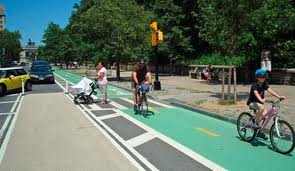
The Prospect Park West cycle track (Park Slope Neighbors website)

Litigation notwithstanding, the new cycle track enjoys the support of 70 percent of the neighborhood’s residents and about half of those who live along the affected street. And according to the Times, a spokesman for the New York transportation department noted that since the track was installed “speeding is down dramatically, crashes are down, injuries are down, and bike ridership has doubled on weekends and tripled on weekdays.”

The mere fact that bike-facility opponents are motivated to litigate shows the depth of opposition that remains toward cycling in America.  Baffling as it may be to regular cyclists, some part of the American public seems to perceive bicycling as a threatening proposition, bad for business and for transportation.  There seems to be a widespread belief that the roads belong exclusively to cars, and that urban transport is a “zero-sum” game: if the cyclists “win,” then cars “lose.”  It’s not that way, of course. Adding bicycles to the transportation mix can actually help decrease traffic congestion and increase overall mobility, as the experience of Copenhagen has demonstrated.

But in bicycle advocacy as in other political endeavors, perception often trumps reality—in fact, perception is reality. So the most important task that bike advocates face is changing the average person’s perception of cyclists and cycling. Until we can do that, bike advocacy will continue to be an uphill fight.
That means that what cycling-advocacy organizations really need is a good marketing strategy.  Even the best product won’t sell without one. So while we should continue to lobby and organize (and in rare instances litigate), we need to realize that just isn’t enough. Perhaps it’s time to bring in the Mad Men. 
Posted in Advocacy, Attitudes, Infrastructure, Legal, Politics, Transportation | 1 Comment

Poster Contest for Fifth Graders: Bicycling is fun…and healthy too!

Calling all 5th graders!

The Bicycle Alliance is serving as the Washington State lead for a national poster contest for fifth graders. The objective is to ask the students to create a poster that reveals his or her understanding of the significant purpose bicycling can play in their community. We want the posters to show the students’ enthusiasm for why bicycling is fun, healthy and green!

Each state’s first place winner receives a Schwinn bike, Planet Bike light, and Lazer helmet and the school will receive a Saris Bicycle Parking System. Each state submits its winning poster to the national contest, and the national winner receives an all expenses paid trip for two to the 2012 National Bike Summit in Washington, DC.
The deadline for submitting posters to the Bicycle Alliance is April 22, 2011. State and national winners will be contacted by National Bike to Work Day on May 20.
Interested? You can find contest details on our website.
You can also contact me at davej@wabikes.org or 206.224.9252 Ext. 302.
And please help spread the word!
Posted in Advocacy, Education, Events, Health, Kids, Sustainable Living | Comments Off on Poster Contest for Fifth Graders: Bicycling is fun…and healthy too!

Legislative Update: Where are we now?

Here’s a quick rundown on the bills that Washington Bikes is working on:

Our Traffic School bill passed out of the Senate Transportation Committee yesterday!  It now moves to the Rules Committee.

The 20 mph bill had a hearing yesterday.  Policy Director Dave Janis testified before the Senate Transportation Committee in favor of it. Washington State DOT raised concerns over an attached amendment that would allow cities and towns of fewer than 3000 to decrease the maximum speed limit on state highways within their jurisdiction.  Watch the hearing on TVW:

The House and the Senate have passed slightly different versions of the Vulnerable User bill.  Today the Senate Judiciary Committee will hold a hearing to consider the house version of the bill.

The Complete Streets bill received a hearing before the Senate Transportation Committee last week.  Bike Alliance board member Bob Duffy testified in favor.

Also of note: SSB 5191, which would have repealed the requirement to include bicycle and pedestrian safety in driver’s education (among other things) died on the Senate floor.

We used Bike Expo has an opportunity to make the cycling public aware of our legislative priorities and we collected nearly 400 signatures in support of the Traffic School and 20 mph bills.  Thanks to all who dropped by our booth and signed the petitions.

Be sure to check our Legislative Page for additional information on our priorities.

Posted in Advocacy, Complete Streets, Issues & Advocacy, Safety, Transportation | 1 Comment

Dexter Avenue: Waiting for a Monolith Moment

Here’s Hoping that American Transportation Planners Move to the Next Level of Consciousness about Bicycling

Devotees of Stanley Kubrick know about the Monolith—that mysterious black obelisk that appears at critical points during “2001: A Space Odyssey” to nudge humankind to a higher level of consciousness.
I have a persistent fantasy: that someday the Monolith will appear in the midst of the conference hall at a national meeting of American transportation planners—or better yet, at the annual meeting of the U.S. Conference of Mayors.
But what would happen if transportation planners and politicians touched the Monolith? What basic truth would they discover through this epiphany? 
In my version of the fantasy, at least, once the cinematic music died down and the lights dimmed, they would be left with a sudden understanding that bicycling really can be an everyday means of transportation for a wide variety of the population, not just a fringe activity undertaken mostly by the young, the brave, the athletic, the (predominately) male and the environmentally inclined. And understanding that truth, they would design bicycle infrastructure accordingly.
For me, the latest reminder that we haven’t yet touched the Monolith comes in the form of the Seattle Department of Transportation’s (SDOT’s) construction plans for Dexter Avenue.
Probably the most heavily-used bicycle-commuting corridor in the City, Dexter currently features narrow and dangerous bike lanes, sandwiched between fast-moving traffic and parked cars and often blocked by double-parked trucks. In short, it’s a dreadful excuse for a major cycling route, one that takes both dedication and a leap of faith to navigate daily.
To SDOT’s considerable credit, Dexter’s reconstruction will result in a significantly more bike-friendly transportation environment, including wide bike lanes that will be separated from motorized traffic by a painted buffer. (In my opinion, the end result would have been better if SDOT had stuck with its original plans to build physically-separated cycle tracks, but that’s water under the bridge.)
The problem is what will happen—or rather, what won’t happen—during construction. The three-phase project, which officially began March 7, won’t be completed until the end of September. During that time, sections of roadway under construction will be two lanes during commute periods, and (at least intermittently) one lane with alternating traffic during other times. The bike lanes will be eliminated in areas under construction, and temporary cycle facilities won’t be built to replace them. In other words, cyclists will be forced to ride with heavy car traffic in the construction zone.
What’s worse, the existing pavement will be ground down, leaving a bumpy and rutted surface for cyclists to negotiate during construction. Add to this the fact that cyclists have to climb a hill going in either direction on Dexter, so the speed difference between cars and bicycles will be considerable.  It all amounts to conditions that would seem to rival the infamous Paris-Roubaix race, not exactly a magnet for your average cyclist with a healthy sense of self preservation.
So far SDOT has not suggested or signed alternative cycling routes for the Dexter corridor during construction, and in fact due to local topography and street conditions there aren’t any good ones. Instead, according to the “Seattle Likes Bikes!” blog, City transportation officials have “stated repeatedly that cyclists will make their own route decisions based upon their individual comfort and ability.” This during the height of commuting season on what is perhaps the state’s busiest bicycle-transportation route.
Underlying SDOT’s statement is the assumption that cyclists are a bunch of hardy road warriors who can fend for themselves. The irony is that as long as SDOT and other transportation agencies continue to make this assumption, it will remain true: a perfect self-fulfilling prophesy. 

On the other hand, if transportation planners want to increase cycling to a level where it actually makes a dent in our urban transportation problems, they have to stop thinking solely of the present cycling community as their “customer base” and focus more on those who don’t commute or run errands by bike, but just might be convinced to do so if the bicycle felt like a safe and convenient alternative to their car.  In simple terms, take the focus off the guy on the $2,000 touring bike and place it on the mom with the kid’s seat on the back of her old cross bike. That means not only building first-class (mostly separated) bike facilities, but also making sure that cycling isn’t effectively foreclosed as an option during construction projects. 

Given the present state of transportation attitudes and infrastructure in the U.S., it’s very hard to convince the average person to get on a bike. Once they do so, you don’t want to lose them. You need to do everything you can to keep them riding. That requires a consistent approach, one that makes the average person feel safe and comfortable no matter what.  Good cycling conditions can’t be a sometimes thing.
The cycling nations of the Netherlands and Denmark understand this. That’s why their cycling facilities tend to be complete, convenient and connected, without gaps; and are designed not only to be safe, but also to foster a feeling of safety on the part of the average person.

Temporary bike path in Copenhagen (Copenhagenize.com)

That’s also why those countries virtually always provide for cyclists during road construction.  Temporary cycling paths are built so that travel patterns aren’t disrupted. Sometimes engineers will even close part of a highway to cars and convert it to a cycle path during a road project, or may even build a temporary freeway crossing for cyclists, as shown in the videos and links on this post by European bike blogger David Hembrow.

So congratulations to SDOT on its efforts on the Dexter Corridor, and I look forward to the final results. But in the meantime, I’ll keep searching for the Monolith.
Posted in Accessibility, Attitudes, Bike Culture, Commuting, Complete Streets, Infrastructure | 2 Comments

Bike Expo is this weekend

Bike Expo. the Puget Sound event organized by Cascade Bicycle Club that features all things bicycle, is happening this weekend.  Be sure to drop by the Bicycle Alliance booth and high five our wonderful volunteers if you’re going to the show. 

We’ll be handing out bike maps, our latest newsletter with our 2011 Rides Calendar (thanks, Bicycle Paper!), Share the Road materials, and more.  We’ll have updated information on ou legislative priorities too.  We’re also doing the popular Share the Road jersey raffle.

There’s lots to see and do at Bike Expo – check the show schedule for specifics.

Posted in Bike Culture, Events, Seattle | Comments Off on Bike Expo is this weekend

New Faces on the Bicycle Alliance Board

Two new faces have joined the Bicycle Alliance board of directors.  The board officially seated and welcomed Jennifer Campos and Joe Platzner at their February board meeting.  Both will serve three-year terms.
Jennifer Campos of Vancouver is our first ever board member from Southwest Washington.  She has been a bicycle and pedestrian planner for over 12 years and currently works for the City of Vancouver.  Some of her major bicycle projects have included a citywide bike route signage system, development of the Vancouver/Portland and I-5 bridge bike maps, and the installation of BikeLink electronic bike lockers and bike corrals in downtown Vancouver.
“Vancouver is unique in that it is part of the Portland (OR) metro area but we can’t access or utilize many of their bike-related programs,” she said.  “I want to help this region better connect with Washington programs and initiatives that benefit bicyclists.”
Jennifer is the mother of two young children who frequently travel with her by bike.
Joe Platzner of Bellevue is a stay-at-home dad.  He is a former aerospace executive with a background in transportation planning.  Joe enjoys the challenge and camaraderie of riding with the Seattle International Randonneurs.  He grew up racing road and track in New Jersey where he worked in bike shops and paid for vacations with a well-used spoke wrench. 
“I am fortunate to be in a position where I have time to donate to projects that I feel passionate about.  I believe that cycling can change people’s lives,” he commented. 

Joe is equally happy riding all night on the winter solstice or taking his young daughter on an “epic ride” to the corner for a kid’s hot chocolate.  Joe believes that we are on the cusp of a great cycling renaissance as we reevaluate our priorities and focus more on energy independence, environmental responsibility, and healthy lifestyles.    
You can read about the rest of the Bicycle Alliance board on our website.
Posted in News, People, Seattle, Vancouver, Volunteer | Comments Off on New Faces on the Bicycle Alliance Board

Bicycle-friendly Legislation Making Progress

The bicycle community is faring well in the legislature.  While we may not get all the funding for programs and infrastructure we want, several policy bills are doing well.  Here’s a quick rundown on where we are:

The Bicycle Alliance is thrilled that our two priority bills are moving well through the state legislature.  As previously reported both  HB 1129, requiring the bicycle and pedestrian awareness curriculum be taught in traffic school , and  SHB 1217, providing local jurisdictions the option of lowering speed limits to 20 mph, cleared the house on a vote of 92-0.  HB 1129 is scheduled for a hearing this Wednesday, March 9, in the Senate Transportation Committee.  It is at 3:30 in Senate Hearing Room 4 of the Cherberg Building.  If you are in Olympia that day, please come to the hearing and sign-in as a supporter.  SHB 1217 was previously scheduled for a hearing on March 10 at the same committee, but has been canceled and not yet rescheduled.  

Here is a link to the membership of the Senate Transportation Committee.  If your Senator is on this committee, please contact them right away and ask them to support both these important bills!   
 
We have actively supported the Vulnerable Users bills, SB 5326 and HB 1339 both of which have passed their respective chambers.   While there may be differences in the bills to reconcile, it appears this bill will finally become law.  Congratulations to the Cascade Bicycle Club for coordinating the multi-year effort to win passage of this bill that sends a strong message that vulnerable users deserve more justice.

Two complete streets related bills are also making progress – SHB 1071, Complete Streets which we previously reported on, passed the house and awaits Senate action.  HB 1700 provides more flexibility with design requirements awaits a vote on the House floor.   

Here is a link to find out who your house and senate members are, and how to contact them. 
Please contact them and ask for their support on these bills that would make our roads safer and work for all users. 
   
A bill of concern is SSB 5191.  A new section of this bill would repeal the requirement that public schools teach the driving around bicyclists and pedestrians portion of the driver education curriculum. This bill is waiting for floor action and we are working to get an amendment to strip Section 17 (4). 

SB 5778 which would have required a 5-cent deposit on drink containers did not make it out of the Senate Environment, Water and Energy Committee and is dead.    

If you want to know more, contact our Policy Director Director Dave Janis at 206.224.9252 Ext 302, or davej@wabikes.org   And watch for frequent blog and Facebook updates.
Posted in Advocacy, Complete Streets, Funding/Policy, Issues & Advocacy, Safety | Comments Off on Bicycle-friendly Legislation Making Progress

Alert: Vancouver’s MacArthur Blvd bike lanes in jeopardy

A year ago, the City of Vancouver conducted a visioning study to make safety improvements along MacArthur Boulevard.  Based on community outreach, an alternative emerged to do a road diet:  reduce traffic lanes to one in each direction, add bike lanes, and enhance pedestrian safety at intersections.  The City has funding to resurface the road and these improvements would occur at that time.
Apparently the Public Works Department has had a change of heart on this project, so it’s time for Vancouver citizens to voice their support for making this a safer corridor for all users.  Please contact the following city officials and tell them that you support the planned road diet, bike lanes and pedestrian enhancements on MacArthur Boulevard.
If you live in Vancouver, please contact the following city officials:
Mayor Tim Leavitt, Tim.Leavitt@cityofvancouver.us
City Manager Eric Holmes, Eric.Holmes@cityofvancouver.us
Public Works Director Brian Carlson, Brian.Carlson@ci.vancouver.wa.us
Here’s a link to the study, but I was unable to get it to work:
http://www.cityofvancouver.us/upload/images/Planning/01%2002%2011%20%20FINAL%20MacArthur%20Vision%20Plan.pdf
I was able to read portions of this document:

http://64.4.176.81/search?q=cache:lfz9b9MXriwJ:www.cityofvancouver.us/upload/images/Planning/01%252002%252011%2520%2520FINAL%2520MacArthur%2520Vision%2520Plan.pdf+macarthur+boulevard&access=p&output=xml_no_dtd&ie=UTF-8&lr=lang_en|lang_ko|lang_ru|lang_es&client=COV01&site=default_collection&proxystylesheet=COV01&oe=UTF-8

Posted in Advocacy, Alert, Complete Streets, Safety, Transportation, Vancouver | Comments Off on Alert: Vancouver’s MacArthur Blvd bike lanes in jeopardy

Women on Wheels: Ladies Night Out

The Bike Alliance at last year’s event.

Tonight is the the 3rd annual Women on Wheels event at Gregg’s Cycle in Seattle.  The folks at Gregg’s will close their Greenlake store early, then reopen at 6:30 pm to women only.

Women on Wheels (WOW) is a celebration of women and cycling–and it feels like a ladies night out!   The atmosphere is festive, with food and drinks, goody bags and raffles.  Women of all ages and cycling abilities attend this event.  Women bring their co-workers and friends, mothers bring their daughters.

The event features clinics, presentations, a fashion show of bicycle wear, and information from bicycle groups.  The Bicycle Alliance will be there so be sure to drop by our table and say howdy.  Free valet bike parking is available, so ride your bike there!

Posted in Events, Seattle | Comments Off on Women on Wheels: Ladies Night Out

We’re Driving Less

Are you driving less?  A recent Sightline post reports that traffic volumes are on the decline in the Pacific Northwest.  Traffic volumes have dropped not only in the urban regions of Seattle and Portland, but across the state highway systems in Washington and Oregon.  Even more interesting:  the trends started before gas prices skyrocketed and the economy took a nosedive.

Posted in Attitudes, Transportation | Comments Off on We’re Driving Less