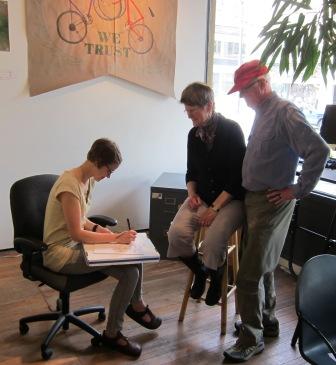
Today’s guest blog post was submitted by Mimy Bailey, a bicycle attorney practicing in Seattle. She handles cases involving collisions and roadway defects. She is a member of Washington Bikes.
After my last post on insurance (Time for an Insurance Check-Up) I received requests for more information relevant to those who gave up their cars. I spent some time calling insurance companies about any available replacement for car insurance and came up empty handed. This post will address some special considerations for those who are car-less.
Before we dive in, I’ll give you the bottom line: There is no car insurance equivalent for the car-less. You want to make sure you have health insurance in case you are hurt and homeowner/renter coverage in case you cause a collision or have a property damage claim.
Car insurance provides three important areas of coverage that comes into play in a bike v. car collision:
- Personal Injury Protection (PIP)pays for medical and other expenses, such as wage loss and household services. PIP is no-fault coverage, so it does not matter who caused the collision, your bills will be paid. The bills are paid as they are incurred (similar to health insurance).
- Car-Less Scenario: You will only have access to PIP coverage if the driver has it on his/her policy.
- Under/Uninsured Motorist Coverage (UM/UIM)will provide insurance if you are hit by someone who is uninsured or whose coverage is inadequate to cover your damages.
- Car-Less Scenario: Not available.
- Liability coverage is mandatory at a minimum of $25k. This is the coverage that you will make the final claim against on the driver’s policy. You must have an auto policy to have this coverage.
- Car-Less Scenario: You don’t have this coverage to take care of the other person in case the collision is your fault (homeowner/renter insurance is the replacement). If it’s the driver’s fault, this is the coverage you will make your claim against.
Is there bicycle insurance?
I know of one company that sells bicycle insurance, but it is not equivalent to car insurance. After reviewing the coverage, it’s not coverage I would recommend.
Can I buy car insurance without a car?
There is no replacement for the type of coverage available to you if you own a car. No car insurance will provide Personal Injury Protection (PIP) or UIM coverage if you are hit on your bicycle, unless your car insurance is tied to your vehicle.
This means that health insurance and homeowner/renter insurance is all the more important. Health insurance to cover your medical bills and homeowner/renter insurance to provide liability protection in case the collision is your fault.
Who will pay my medical bills if I am hit by a car?
IF the driver has PIP coverage on his/her policy, then it will pay medical bills up to the limits of the coverage (usually $10k, $25k, or $35k).
If the driver has no PIP coverage, or you max out the coverage, you need to have medical insurance to cover your bills.
Am I limited by the driver’s insurance coverage? Can I go after him/her personally?
It is possible to go after the driver’s personal assets, but this is considered a last resort to be exercised in rare circumstances.
What coverage do I have when driving a Zipcar?
Zipcar provides liability and PIP coverage for members when driving one of their cars. Learn more here.
Am I covered when I borrow a friend’s car?
So long as you have your friend’s permission to use the car, you will be covered on your friend’s policy. That said, it’s always a good idea to call the insurer to make sure.
What if I cause injury to someone else while riding?
In this scenario, you will be concerned about liability coverage to take care of the harm you caused to another person. Homeowner/renter coverage may provide general liability coverage in this scenario.
What if I am involved in a bike v. bike or bike v. pedestrian crash – what insurance coverage applies?
Most likely, the only available coverage will be homeowner/renter if carried by the at-fault person.
What if my bike is stolen?
Again, you will make the claim on your homeowner/renter policy. It will be helpful if you have pictures of the bike and a receipt for the original purchase.
If you have other questions about insurance or some of the information provided is unclear, send me an email and I’ll be happy to clarify mimy@seattlebicycleattorney.com