30 Days of Biking Washington

What did your father or mother, aunt or uncle, grandma or grandpa tell you when you first learned to ride a bike and fell down? Probably something like this:

“You can do it! Get right back on the bike.”

In other words, the key to riding a bike was to stick to it.

In a way that’s the premise of 30 Days of Biking, along with the science that tells us that if you commit to something in writing you’re more likely to complete it.

In its fourth year, 30 Days of Biking asks just one thing: Pledge to ride your bike every single day for 30 days. Whether you take your bike out of the garage and wheel it around the block for a breath of fresh air before bedtime or take off on a 100km randonneuring expedition, ride every day.

We know Washington is the #1 Bike-Friendly State in the nation (5 years running!). Can we be the #1 state for participants in 30 Days of Biking?

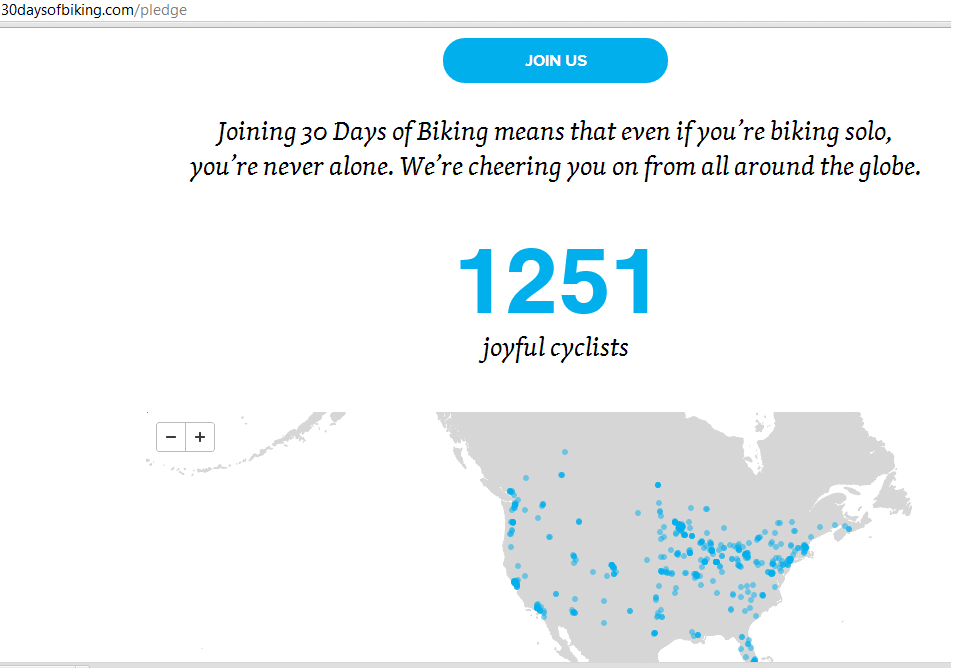
Map of 30 Days of Biking registrants as of 3-16-13If we want that title, though, we need to rally a lot of people to sign up. Minnesota is kicking our 30-days saddle, with over 300 registrants already, and California has over 200. We’re ahead of Oregon, but just barely.

Cities and towns all over Washington are already represented: Bellingham, Spokane, Cheney, Woodinville, Vashon, Mountlake Terrace, Seattle, Snohomish, Lynnwood, Ellensburg, Olympia, Fife, Walla Walla, Tacoma, and Vancouver so far.

If your dot isn’t on this map yet, sign up and tell us in the comments below. We’ll report our rankings again before April 1 when we all get rolling.

If you’re blogging about your 30 days of biking, let us know that too–we’ll post a round-up of your experiences undertaking the challenge. For those of you on Twitter make sure you use #30daysofbiking in your tweets; add #bikeWA or @bikeWA and we’ll spot them.

Some motivators for you:

  • Think of it as a warm-up for National Bicycle Month in May.
  • It might be a way to get one of your friends who’s been considering riding to head out with you: “Help me stick to my pledge–ride to the coffee shop with me Saturday.” (Another bit of science tells us we’re more easily persuaded to do something by someone we like or admire, so you’ll be inspiring your friend under the guise of your friend helping you.)
  • You could check out somewhere you haven’t ridden before, either in your city or as a weekend destination to a regional trail. (Bonus points: Could you bike in a different place in Washington every day for 30 days? Take it on and write a guest post for us about the experience!)
  • If you’ve been a recreational rider for years but haven’t done any errands by bike, now’s your chance. A grocery store run for a few items or your first time riding to work will help you check the box.

Ready to roll for 30 days in a row?

Posted in Events, News | 9 Comments

Gear Grinder Blend: Delicious Support for the Bicycle Alliance

Label design for Gear Grinder Blend, coffee that benefits Washington BikesWe know how you start your day: Looking forward to that first jolt of caffeine in the system to help get you rolling. Let us make it even easier for you by having the coffee delivered straight to your door!

Our friends at Roast House Coffee in Spokane have cooked up Gear Grinder Blend to benefit the Bicycle Alliance. Organic, farm-to-cup fair-trade coffee in compostable bags and it benefits bicycle advocacy? Doesn’t get much better than that!

Roast House owner Deb Di Bernardo has long supported bike events in Spokane with donated coffee, from the Bike to Work Kickoff Breakfast put on by Spokane Bikes to races and rides like the great fall family ride Spokefest. As their site says, they’re “Spokane’s small, local, artisanal, goody-two-shoes roasting company.” Further evidence: Deb delivers coffee by bike to many of the Spokane coffee shops that serve her roast.

Available in dark French roast, medium roast, and medium roast decaf for those late-night cups to accompany your dessert, this is a smooth, delicious coffee. You can order it online; the price includes all sales tax and shipping and these bags are a full 16 ounces–an actual pound of coffee instead of the 12-ounce bags so common on the shelves these days. Your purchase benefits the Bicycle Alliance and supports a business dedicated to biking and sustainability.

Gear Grinder Medium Roast: Deb says this is her personal favorite for French press every morning, and that “In blind taste tests this blend kicked the pants of the Italian imports.”

Ethically sourced Mexican and Nicaraguan coffees combine to create a blend that showcases flavors of delicate chocolate and dry cocoa with mild acidity and a silky body. While it reminds some people of pudding, the blend turns sweet and tangy when prepared as espresso.

Dark Roast: This three-bean blend of sustainably grown and ethically sourced Mexican, Brazilian and Papua New Guinea is roasted to a deep, dark mahogany, revealing a pungent, bittersweet, smoky aroma. A splash of cream is the perfect finish for this intense brew, which is recommended for espresso, drip, French press and pour-over preparations.

Medium Roast Decaf: Ethically sourced, certified organic coffees from the most reputable cooperatives in Latin America, Indonesia and Ethiopia, roasted to bring out the depth of flavor that’s only possible in decafs processed in the chemical-free Swiss Water Process. It’s a deeply satisfying brew that’s 99.9% light on caffeine but heavy on flavor.

Fueled by caffeine!

Note: If you’re in the Seattle area, you can check with the office (Elliott at 206-224-9252 ext. 300) to see if we have some bags on hand to save on shipping. That’s not front-door convenience like the home shipping option but we welcome visitors!


Posted in News | Comments Off on Gear Grinder Blend: Delicious Support for the Bicycle Alliance

Streets are for Everyone: Involving Children in Tacoma’s Complete Streets Program

This post originally appeared on The Congress for the New Urbanism’s blog, CNU.org/salons. The post was written by Nicholas Richter and Josh Jorgensen, planning interns for the City of Tacoma.

THE PROJECT

Tree-lined streets.

What started as a project for two planning interns with the City of Tacoma has turned into a transformational partnership between the City of Tacoma, McCarver Elementary School, and many other local community organizations and firms.

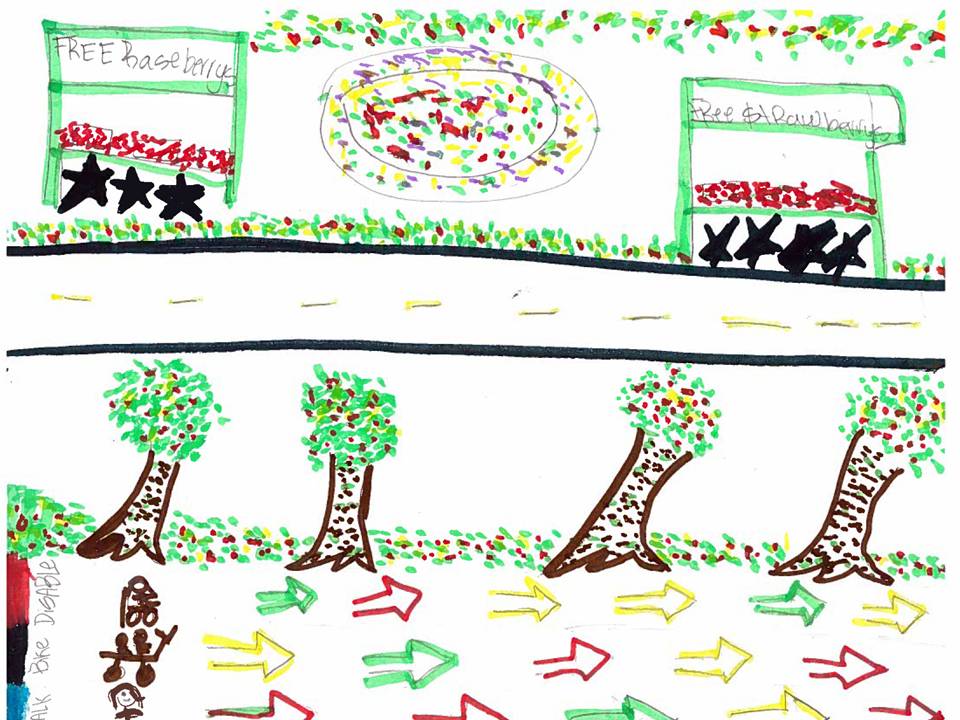
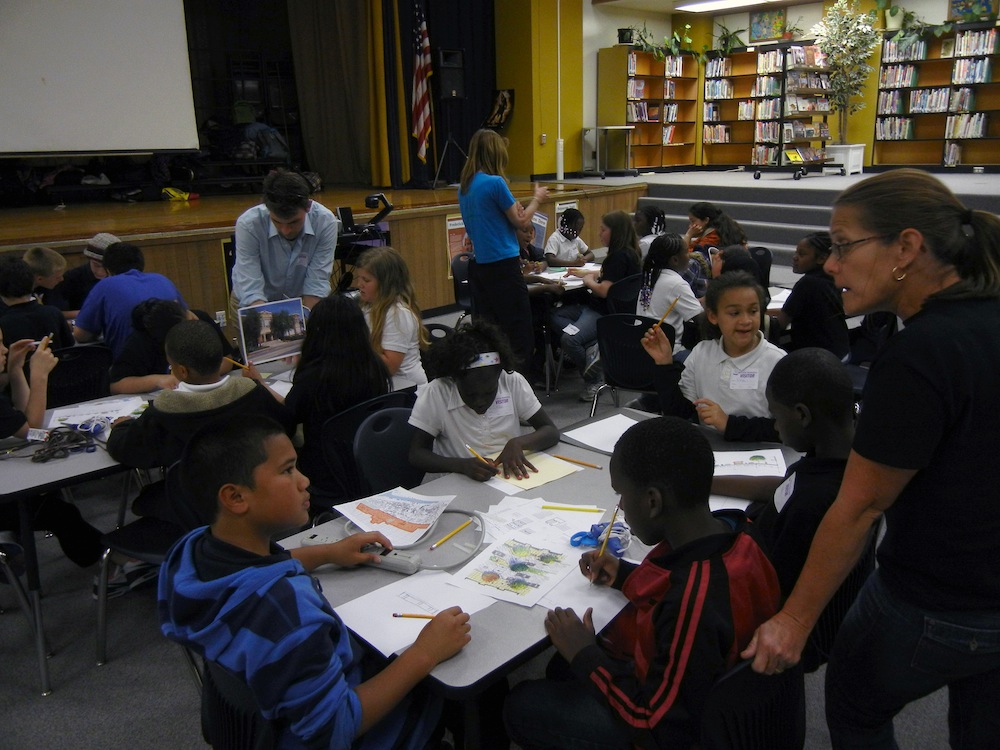
The project brought planning to the classroom with a series of activities including visioning exercises and charrettes that focused on neighborhood safety and what community meant to elementary school children. As part of these activities, children were asked to illustrate their ideas and these drawings were the inspiration for a complete streets primer specifically for the neighborhood where the school is located, called “35 Ways to Safer Neighborhood Streets”.

The complete street primer (available here) is a natural extension of the City of Tacoma’s award winning citywide complete street guidelines. The booklet covers 35 specific traffic calming treatments and programs available to the local community. The inspiration for the booklet came after seeing that many pictures that the school children had drawn were directly related to real engineering solutions that are used in communities around the country to ensure that traffic on residential streets stay at residential speeds.

The end result of their efforts is a 60 page, full color guide to some of the most effective treatments outlined by leading bike and pedestrian development guides, complete with local examples and illustrations by the children at McCarver Elementary School. The booklet also includes a planner supplement at the end that outlines some of the key takeaways from the experience of working in a classroom setting.

THE MESSAGE

The way our streets are designed greatly influences the way we interact socially. Safe streets directly contribute to a child’s ability to independently get around their own neighborhood by providing a safe environment for walking, biking, and play. Therefore, if streets are not complete, they are “incomplete.”

McCarver students envision Complete Streets.

The danger that incomplete streets pose to children has always been a concern across the nation, but until recently instead of progressively prioritizing those with limited abilities or developmental restrictions, such as children, we have prioritized vehicle speeds and volumes. Among the children that participated in charrettes at McCarver, many were excited about the idea of having access to places where they felt comfortable walking and biking, both as a safe routes to their school and as safe way to get to their friend’s house, the park, or other places they wanted to be.

The City of Tacoma is currently working on a subarea plan for the MLK District, where McCarver Elementary School is located. The plan envisions a well-connected, mixed-use neighborhood with strong multimodal connections to other areas of Tacoma. The “35 Ways to Safer Neighborhood Streets” booklet aims to highlight the great work done by the children at McCarver Elementary School while also providing local residents with an introduction to neighborhood traffic calming tools and complete street concepts.

Top 3 Takeaways for Involving Children in Planning at the Classroom Level

  • Engage students — make sure the material you are presenting is grade appropriate and fun. Lessons that are too hard or too easy for students will leave them frustrated or bored, which will be palpable. If you’re unsure about this, discuss with the teacher prior to your visit.
  • You are a visitor — classroom management is difficult when you do not know the kids or are familiar with their routines. The more engaged the students are, the fewer problems you will have.
  • Praise, praise, praise. — Leave the classroom in the same or better mood than you arrived! Keep it as positive as possible! Students are more likely to follow directions and stay on task if they feel like you like them! Praising students and making them feel good about themselves will leave a good impression on the teacher and the kids.

More tips on working with children in planning work can be found starting on page 53 of “35 Ways to Safe Neighborhood Streets”, available here: http://www.cityoftacoma.org/MLKPlan-McCarver

Posted in Accessibility, Attitudes, Complete Streets, Infrastructure, Safe Routes to School, Safety, Tacoma | 1 Comment

Will we see you at Bike Expo?

If you’re a bicyclist in the Seattle region or connected to the area cycling community, you’d be hard pressed not to know that this weekend is Bike Expo.

Bike Expo is the largest consumer bike show in the country. Organized by Cascade Bicycle Club, this event features over 250 industry-related booths. You’ll find bicycle and gear manufacturers, bike shops, ride/event organizers, health and fitness pros, bicycle nonprofits – all under one roof. And yes, you’ll find us there as well!

But wait, there is more. There will be a bicycle photo exhibit, interactive areas, and lots of interesting programs. You might want to check out the popular Traffic Stoppers fashion show presented by Hub & Bespoke. The show features modeling talent from local active transportation organizations, including the Bicycle Alliance’s own Barb Chamberlain and Seth Schromen-Wawrin!

Look for the Bicycle Alliance booth on the main floor. Drop by to say hi, pick up some bike maps, join or renew your membership (we’re offering a Bike Expo special), and sign up for a free drawing for a RAPSody – Ride Around Puget Sound registration.

Visit Cascade’s Bike Expo page for the complete lowdown on this event.

Posted in Bike Clubs, Bike Culture, Events, Seattle | Comments Off on Will we see you at Bike Expo?

Will the State Senate Vote to Help Slow Traffic in Your Neighborhood?

The answer to the question in the title above–Will the State Senate vote to help slow traffic in your neighborhood?—is “It depends.”

It depends on you taking action right now to ask your state senator to vote yes for SB 5066, our Neighborhood Safe Streets Bill.

SB 5066, the Neighborhood Safe Streets Bill, should be coming to the floor of the Senate for a vote in the next day or so. Its companion bill, HB 1045, recently passed the House with strong bipartisan support, 86-10.  It’s time to ask your state senator to vote yes for safer streets, less red tape, and cost savings for taxpayers.

SB 5066 is simple: It allows cities to save our tax dollars by letting them slow speed limits on non-arterial streets to 20 mph without having to spend money on a traffic and engineering study, as long as they set up a procedure for decision-making on the change.

Safer streets: When you, your neighbor’s child, or your grandmother gets hit by a motor vehicle at 25 miles per hour (the de facto speed limit on many non-arterial streets) versus 20 miles per hour the consequences are far more serious. This is especially true for the elderly.

According to a 2011 report by AAA, a person’s chance of being severely injured sharply increases as vehicle speeds increase (odds of serious injury go from 10% at 16mph to 50% at 31mph). The risks are far greater for older people. This is why AARP strongly supports SB 5066.

An additional study shows the chances of death at 5% when you’re hit at speeds of 20 MPH, versus a 45% likelihood of death when you’re hit at 30 MPH.

Safe, walkable streets are important for safety and livability, and they improve the quality of our schools and neighborhoods—this is why so many of the partners we work with on Safe Routes to School support this bill.

Less red tape and cost savings for taxpayers: Cities already have traffic and transportation plans in place developed with the expertise of professional engineers. They already have the power to lower the speed limit to 20mph. They just can’t lower it without doing another study.

The Washington State Association of County Engineers estimate the cost of such studies at $1,000 to $5,000 for jurisdictions that can assign the studies to staff in-house, with costs higher for smaller jurisdictions that have to employ outside consultants. SB 5066 would let cities spend that money on actually making safety and traffic improvements instead of conducting yet another study. This is why the Association of Washington Cities and several individual cities support the bill.

You’re with us on this. Now what?

Contact your legislator. Enter your mailing address on the district finder form (choose Legislative, not Congressional) and follow the instructions on the site to reach a contact form.

Choose your state senator and ask for a YES vote on the floor for SB 5066.

Points you could include in your email:

  • HB 1045 is about local control, increasing government efficiency by cutting red tape and expense, and making neighborhood streets safer.
  • HB 1045 has bipartisan support. The Senate bill (SB 5066) passed out of the Senate Transportation Committee with unanimous “do pass” support. The House companion bill (HB 1045) recently passed the House 86-10. In the previous biennium, this same legislation passed out of the House twice. This is the year to get it done!
  • HB 1045 can save cities and towns money by removing the requirement for an engineering study. It’s smart policy that removes unnecessary regulation over a decrease of 5mph. This change lets cities spend that money on actually making safety and traffic improvements instead of conducting yet another study.
  • The elderly are most vulnerable to collisions at speeds above 20 MPH. As we look to create safe neighborhoods for our increasingly elderly population, slower streets are more forgiving to those whose mobility is affected by the highly individual process of aging. Design practices that explicitly recognize aging will better serve a growing segment of the nation’s population.
  • Safe, walkable streets are important for safety and livability, and they improve the quality of our schools and neighborhoods—so kids can walk and bike and so parents can feel safe sending their kids to school.
  • This bill could be an especially helpful tool in the toolbox of cities and towns to reduce cut-through traffic on neighborhood streets off of arterials and onto non-arterial streets, which affects property values, safety, and livability in cities and towns across Washington. 

Our Legislation & Statewide Issues page lists the issues and bills we’re following so bookmark that, follow us on Twitterlike us on Facebook, and ask your friends to sign up for our email Action Alerts to keep pace with the session as it speeds up.

Stay tuned and stay active!

Earlier Action Alerts give you more background on the bill’s progress and other issues:


Posted in Advocacy, Issues & Advocacy, Legislature, Safety | 3 Comments

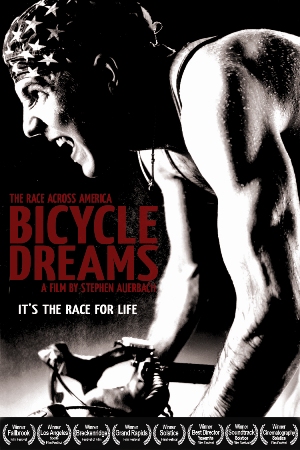
Bicycle Dreams coming to Seattle on March 14

Bicycle Dreams, the award-winning feature-length documentary about the Race Across America (RAAM), will premiere for the first time in Seattle at the Harvard Exit Theatre on Thursday, March 14 at 7 p.m. The screening is presented by Washington Bikes.

The film, which has won numerous awards at film festivals all over the world, “is an up-close look at what RAAM riders go through,” says Stephen Auerbach, the director and producer of Bicycle Dreams. “They deal with searing desert heat, agonizing mountain climbs, and endless stretches of open road. And they do it all while battling extreme exhaustion and sleep deprivation. It’s a great subject for a film.”

We hope you’ll join us for this special big screen showing of Bicycle Dreams. In addition to the movie, we will feature a brief presentation by Ben Robinson of Seattle. Ben, a past RAAM participant and former board member of the Bicycle Alliance, will share his personal experience riding this demanding event. There will also be a cash raffle with proceeds benefiting the Bicycle Alliance.

Tickets are $11 in advance and $15 at the door the night of the show. To purchase advance tickets, order online at www.landmarktheatres.com/market/seattle/harvardexittheatre.htm. The Harvard Exit is located at 807 E. Roy Street in Seattle.

Posted in Bike Culture, Events, Seattle | Comments Off on Bicycle Dreams coming to Seattle on March 14

Safety Education Makes a Difference

Jefferson Elementary in Port Angeles recently finished teaching the Bike and Pedestrian Safety Education curriculum to their 5th grade students. The PE teacher sent a short note to us about why she values the curriculum:

I had 7 non-bike riders at Jefferson this year when I started teaching the Bike and Pedestrian Safety Education curriculum. Now 5 of them are able to ride on their own!  Three of them have bikes at home that just sat there before because they didn’t know how to ride.  Now they go home and ride their bikes every day!! The two remaining non-riders are autistic kids with special needs.  But they can now sit on the bikes and push the top pedal to get started, and sometimes pedal a few rotations.  It is so exciting to see the kids take off riding!

Comments like this remind us the many reasons that safety education is valuable for our youth. Students are learning the rules of the road and how to be safe while riding. But almost every class that teaches the curriculum is like this one with a few students who do not know how to ride. The students are also learning about lifelong physical activity and how to use their bodies. Each year, of the approximate 10,000 students who go through the program, hundreds are learning to ride for the first time.

Posted in Education, Encouragement, Kids, News, Olympic Peninsula, Safe Routes to School, Safety | Comments Off on Safety Education Makes a Difference

Helping Kids Bike and Walk to School: Legislation to Grow Safe Routes to School Needs Your Help Today

2012 brought its ups and downs for investments in Safe Routes to School – an oversubscribed state grant program that increases physical activity by getting kids walking and biking, improves safety and reduces vehicle citations, and improves concentration in academics.

First, the additive fee bill passed in the legislature and signed by the governor in spring 2012 brought a much-needed influx of state investments for the growing Safe Routes to School program. We say “additive” because the goal of the bill was to increase investments above and beyond where they were with federal and state funding.

www.pedbikeimages.org / Dan Burden

Unfortunately, the progress forward in Safe Routes to School threatened to disappear just months later with the passage of the two-year federal transportation bill. Moving Ahead for Progress in the 21st Century (MAP-21) diminished direct federal funding for walking and biking by at least 35%. With hard work and full-on campaigning, Washington Bikes with help from our friends at the Transportation for Washington Campaign worked to restore funding to the 2009-11 biennium levels for federal funding in Safe Routes.

State budgets have to be based on some assumptions about the level of federal money coming in. But unfortunately, the next two years of federal funding for Safe Routes to School will still fall short of the dollars assumed as a base for Safe Routes when the state legislature made its additive fee bill investments last spring.

That’s where Senate Bill 5506 comes in. This bill seeks to provide certainty by ensuring that the level of federal funds dedicated to Safe Routes to School grants will remain the same as the last two years by establishing a floor of federal funding. Under MAP-21 the state has flexibility in redirecting some of its funds to make this possible. This week SB 5506 needs your help to get voted out of the Senate Transportation Committee. Our friends at the Childhood Obesity Prevention Coalition have an action alert ready to go.

SB 5506, sponsored by Senator Andy Billig (Spokane), helps guarantee that we continue to grow investments that already show results. Seventy percent of the Safe Routes to School projects in Washington state that were awarded between 2005 and 2009 have been completed. At schools with completed projects, the number of children biking and walking has increased by over 20 percent.

Additionally, Safe Routes to School projects have brought new infrastructure and safety improvements, along with reductions in motor vehicle citations. Washington state Safe Routes to School investments have added 75,000 feet of new sidewalks near schools, and reduced  motorist speeds and traffic citations. For completed projects, so far no collisions involving bicyclists or pedestrians have been recorded at Safe Routes to School project locations after project completion.

By drawing partially from the Highway Safety Improvement Program (HSIP), SB 5506 continues to make the explicit linkage between child safety and roadway safety as 14% of all serious injuries and deaths in Washington occur when walking or biking and yet HSIP funds currently expend less than 1% to fix this problem. Similarly, walking on Washington state streets constitutes the third leading cause of death for our kids.

Making the link explicit between highway safety and walking and biking is a priority of Washington Bikes. With our work on MAP-21, we’re carrying it on in supporting SB 5506, working on the update of Target Zero (the Washington state strategic highway safety plan), and by working with our legislators and WSDOT.

Here at Washington Bikes, we’re proud to advocate and grow the linkage between road safety investments and getting kids to walk and bike. Next week we’ll be sharing it with advocates across the country at the National Bike Summit in Washington D.C.

Back here in the other Washington, we’ve got work to do this week. Please visit the Childhood Obesity Prevention Coalition’s action alert, send it out, and let the Senate Transportation Committee know about the great reasons to vote YES on SB 5506.


Posted in News | Comments Off on Helping Kids Bike and Walk to School: Legislation to Grow Safe Routes to School Needs Your Help Today

It’s Ladies Night Out at Women on Wheels

Bike Alliance at a past WOW event.

This Thursday Gregg’s Cycles is hosting its 5th Annual Women on Wheels. The good folks at Gregg’s will close their Greenlake store early, then reopen at 6:30pm to women only.

This free event offers complimentary wine, beer and appetizers, and it’s packed with lots of products and information aimed at the woman who bikes–or wants to bike. WOW features inspirational speakers like April Streeter, author of Women on Wheels Book. It brings industry reps in to showcase and discuss their products for women, and it features nonprofits (like us!) who encourage more women to bicycle.

WOW has been hugely popular in the past, so you’ll want to arrive early! There will be goodie bags for the first 350 guests and a raffle ($1 per ticket – cash only) to benefit the nonprofit organizations. Indoor bike valet parking is also provided, so don’t hesitate to ride your bike!

The Bicycle Alliance will have a table at WOW. We’ll offer a membership special and distribute information that can help you with your commute or recreational rides. So be sure to drop by our table to say hi, join or renew as a member, and buy some cash raffle tickets!

Click here to learn more about Women on Wheels and to register for this free event.


Posted in Bike Culture, Encouragement, Events, Seattle | Comments Off on It’s Ladies Night Out at Women on Wheels

Sound Transit to Add Bike Parking at Mount Baker and Beacon Hill Stations

Photographs by the author

On Wednesday February 13, Sound Transit (ST) staff, members of the ST Bicycle Advisory Group and other interested parties took a tour of the Mount Baker and Beacon Hill light rail stations. The purpose of the tour was to see the existing bike parking facilities and hear about the upcoming improvements to the bike parking facilities at these two stations. I attended the tour as a representative of Washington Bikes alongside board member King Cushman and former board president Arnie Tomac.

We met at the International District/ Chinatown Station and rode to the Mount Baker Station for the first segment of the tour.

Mount Baker Station

After seeing the facility there and discussing future developments we traveled to the Beacon Hill Station and toured that facility.

Beacon Hill Station

Since we were doing well on time, we took a small detour to the Beacon Hill Greenway where we heard from Dylan Ahearn of Beacon BIKES about the development of the Greenway.

Beacon Hill Greenway

Sound Transit has been retrofitting additional bicycle parking at the light rail stations from Stadium station to the SeaTac/ Airport Station. Two of the last stations to receive retrofitting are the Beacon Hill and Mount Baker stations. At the Mt. Baker station there are currently two bike lockers with four secure spaces and two racks with capacity for 16 bikes. The retrofit as planned will add 10 more bike lockers to provide 20 more secure spaces.

At the Beacon Hill station there are currently two bike lockers with four secure spaces and three racks with capacity for 24 bikes. The retrofit as planned will add a bike cage with 24 spaces initially, and space reserved for another 24, should there be sufficient demand. The racks that will be installed in the cage are a two-tiered system that is very space efficient—and is similar to the racks that were used in the Bike Port .

Currently, the Beacon Hill station has five people on the waiting list and the Mount Baker Station has six people on the waiting list for bike lockers. At the Bicycle Alliance we see the increased bicycle parking capacity at Sound Transit stations as a step in the right direction though we would like to see more bike parking in the future. The waiting lists for bike lockers at Sound Transit and King County Metro transit stops throughout the region is a clear indicator of current demand and an indicator of latent demand for bike parking at transit stops.

It is generally accepted by urban planners that people will walk up to half a mile to a transit stop. Similarly people will bike at least two or three times that distance to a transit stop, especially if the multi-modal experience has smooth transitions.  By making better provisions for biking to the light rail and for parking bikes at the stations, there is an opportunity to increase rail ridership substantially. At Washington Bikes we are enthusiastic to see Sound Transit retrofitting their stations to increase bicycle parking.

Posted in Accessibility, Bike Parking, Bike to Work, Commuting, Infrastructure, News, Transit, Transportation, Travel | Comments Off on Sound Transit to Add Bike Parking at Mount Baker and Beacon Hill Stations