You’ve come a long way, baby!

Eric Berg of JRA Bike Shop recently got his hands on a copy of Seattle’s first bike plan and he shared it with us. We have posted a copy of the 1972 Comprehensive Bikeway Plan on our website for your reading pleasure.

In 1972, Seattle had only 8 miles of trail where a cyclist could “ride without fear of an automobile running him down.”  The city also had 32 miles of “bicycle safety routes”–routes on park boulevards or residential streets that were meant for recreational cycling.

Recommendations from this first plan included establishing bike routes with a transportation function, developing a voluntary bicycle registration program, and establishing a program to help install bike racks in key locations around town (only one or two bike racks existed in the Central Business District in 1972),

Fast forward to 2007.  Seattle now has 40 miles of trails, 25 miles of bike lanes, a 24/7 indoor bike parking facility and, following an intense public process, City Council approves the Seattle Bicycle Master Plan.  This aggressive ten-year plan calls for tripling the amount of trips made by bike, reducing the rate of bike crashes by a third, and expanding the bicycle facility network to over 450 miles.

According to a March 2010 progress report posted on the Seattle Department of Transportation (SDOT) website, bike plan accomplishments include 93 miles of bike lanes and sharrows, 31 miles of signed bike routes, installation of 801 bike racks-including 3 on-street parking facilities, distribution of over 60,000 bike maps, and funding the Bike Smart education program.

While there is much more to accomplish if Seattle is to achieve its ten-year goals outlined in the Bicycle Master Plan, the progress that has been made in the past three years is noticeable.  And if you compare today’s bike infrastructure to what existed in 1972, what a difference a few decades have made!

Posted in Advocacy, Attitudes, Funding/Policy, Infrastructure, Seattle, Transportation | Comments Off on You’ve come a long way, baby!

The future is worth a thousand visions

The future is worth a thousand visions–or so believes the Spokane Regional Transportation Council.  SRTC is in the midst of updating its long range transportation plan and they are employing a unique strategy to engage the community for feedback. Citizens are encouraged to play an online interactive game called A Thousand Visions and SRTC hopes that at least a thousand folks play this game and submit their results.

Cyclists pass Riverfront Park on their way to work.

This game is a fascinating exercise in transportation planning and resource allocation.  You, the player, are given a baseline transportation budget then you must decide how you will raise additional revenue to fund the projects of the future.  You might choose to raise property taxes, enact a special sales tax for transit and increase the local gas tax.  The game calculates how much revenue each source will raise and it tells you approximately how much the financial burden will be annually on a household.

Assuming you have survived a tax revolt, it’s time to fund the transportation projects of the future.  Do you build new roads and complete the North Spokane corridor?  Do you invest in a new high performance transit system for the region?  Do you complete the Fish Lake Trail and fund the regional bicycle and pedestrian network?  You learn how much it costs to fund a project and the game calculates whether or not you have raised enough revenue to fund your projects.  You will most likely find yourself forced to scale back projects or drop them completely.

A Thousand Visions is available to play until November 29.  If you live in the Spokane region, please play the game and submit your vision results.  If you live elsewhere, you can still play the game without submitting your results.  It’s a thoughtful exercise in transportation planning and funding.

Posted in Funding/Policy, Infrastructure, Spokane County, Transportation | Comments Off on The future is worth a thousand visions

Channeling Ian Hibell

If there were a contest for coolest bicyclist ever, Ian Hibell would win, hands-down.

You may be forgiven for asking: Ian who?  Hibell remains an obscure figure, especially outside his native England, to all but a few cyclists and adventure-travel buffs who happen to read the right magazines or assiduously surf the Internet.

But to me, he best represents the possibilities for adventure, discovery and serendipity that a bicycle can bring, if you let it.
I first discovered Hibell several years ago when I opened my new issue of Adventure Cycling magazine to find an article by him about his adventures.  The article was accompanied by two-page photo of Hibell on his touring bike, grinding his way up the rocky road to Machu Picchu in Peru. Below him, going on seemingly forever, stretched the route up which he had come.  To me that one photo perfectly captures the possibilities that a bicycle can unlock.
Hibell was a true British eccentric in the positive sense of the term. He grew up in mostly rural but decidedly civilized Devonshire, in the Southeast of England.  His first experience as a cycle tourist was borne of a combination of accident and necessity, when his father could not afford train tickets to send the entire family to the seaside for a vacation. So Hibell and his dad rode their bikes there, sleeping on park benches and wherever else they could.
As an adult, Hibell worked for a local English telephone company for a time, but soon found that the allure of the open road trumped the comforts of a nine-to-five job. He spent the next 40 years as a nomad on a bike, never really settling down.  He rode from Bangkok to Vladivostok. He rode from Norway to the Cape of Good Hope.  He rode from the tip of Tierra del Fuego to Alaska. He rode across the Sahara Desert, almost dying of thirst before he was rescued by a band of tribesmen. He buried himself in mud to escape hoards of mosquitoes.  He was chased by rogue elephants and almost eaten alive by tropical ants.  He was shot at and jailed. He crossed the notorious Darien Gap in Panama (an adventure captured in this vintage film). His family knew him fondly as “mad uncle Ian.”
Ironically, it wasn’t the wilderness that killed Hibell, but civilization. After 40 years on the road, Hibell was killed by a hit-and-run driver on the Athens-Salonika Highway in Greece while on a training ride for another adventure.
But I like to remember Hibell for his adventures rather than his end.  And I think it’s a good thing for all cyclists to channel Ian Hibell occasionally.  If you want to cycle across the Sahara or brave the Darien Gap, great. Long-distance touring is fabulous.  But you don’t have to go that far to get a taste of adventure. Just try something new.  Go camping on your bike. Explore some local logging roads. Go up a valley that you’ve driven by but have never been to.  Sometimes there’s great joy to be had in breaking your routine to discover the simple pleasures of an unexpected mountain view, or eating a cheese sandwich in the fall sun while listening to the wind in the firs, or even getting a little lost. And after you’ve done it, raise a toast to Ian.
Posted in Adventure, People | 2 Comments

Transitional Thoughts

SpokeFest

I’m writing today not as a volunteer-seeker, regular bicycle commuter, for outreach, as a trainer or organizer, or make-it-happener. Although I’ve worn all of those hats, my time at Washington Bikes in those roles ends on November 18. Louise asked me to write a short blog about my leaving, and I would like to take a moment of your time to speak from my heart.

What I would like to say, and for you to hear, is: Thank you.
Tour de Fat

When I started with the Bicycle Alliance in January, I truly had no idea what I had signed up for (and, it turns out, nobody else knew, either!). Over the next 10 months, I did all sorts of things: I learned enough about volunteer programs to write a Master’s dissertation on the subject; I helped organize and staffed lots of outreach events; I organized all sorts of other things, from bike classes to a United Way Day of Caring project; I helped the staff start using a more systematic way of bringing new volunteers. I could spend an entire blog post listing the specific events and activities I helped with, and each of those had great value.

Looking back, though, what I take away is far more than the sum of the discrete experiences. Instead, I’ve begun to learn some deeply important lessons that may take a lifetime of reinforcement to truly sink in:

  1. To keep your responsibilities from overwhelming you, focus on the small things that make up the bigger picture.
  2. Be persistent. Keep putting one (metaphorical) foot in front of the other even if it feels like you’re not getting anywhere.
  3. No matter how diligently-planned and meticulously organized an event or program is, things still won’t go the way you want. That’s not only OK, it’s normal and good. Accept that as success.
  4. Look at problems as opportunities instead of obstacles. Sometimes just changing how you think about a situation can change it from insurmountable to… well… surmountable.
  5. Every experience is a learning experience, and every experience you learn from is a success.
Women on Wheels

You, the loyal, patient, and helpful Bicycle Alliance supporters have taught me this through your commitment and willing support. Thank you from the bottom of my heart. Thank you for these 10 months of learning and growth, 10 months of trying and succeeding, 10 months immersed in bicycling culture. Thank you for welcoming me with open arms, for this opportunity, for the time with you.

Of course, saying all that, I haven’t answered the natural question: What’s next? Although the future looks murky (and really, who can predict their future with any reliability?), I hope to continue my relationship with Bicycle Alliance, albeit in a slightly different capacity: as a bicycle education teacher for several of the big grants that the Bicycle Alliance received in the last few months. So although I won’t have the same 40-hour-a-week presence you’ve become accustomed to, November 18 marks a transition rather than an ending.

See you all out on the road. You’ll know me by the reflective helmet streamers.
Manchester Bike Ride - Postride
Posted in People, Volunteer | 3 Comments

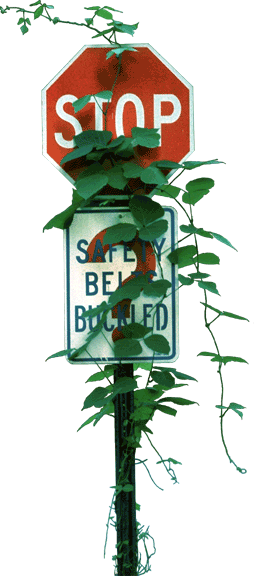
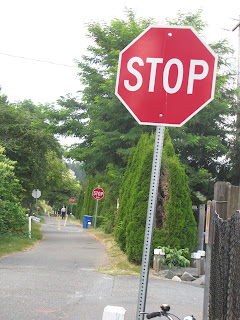
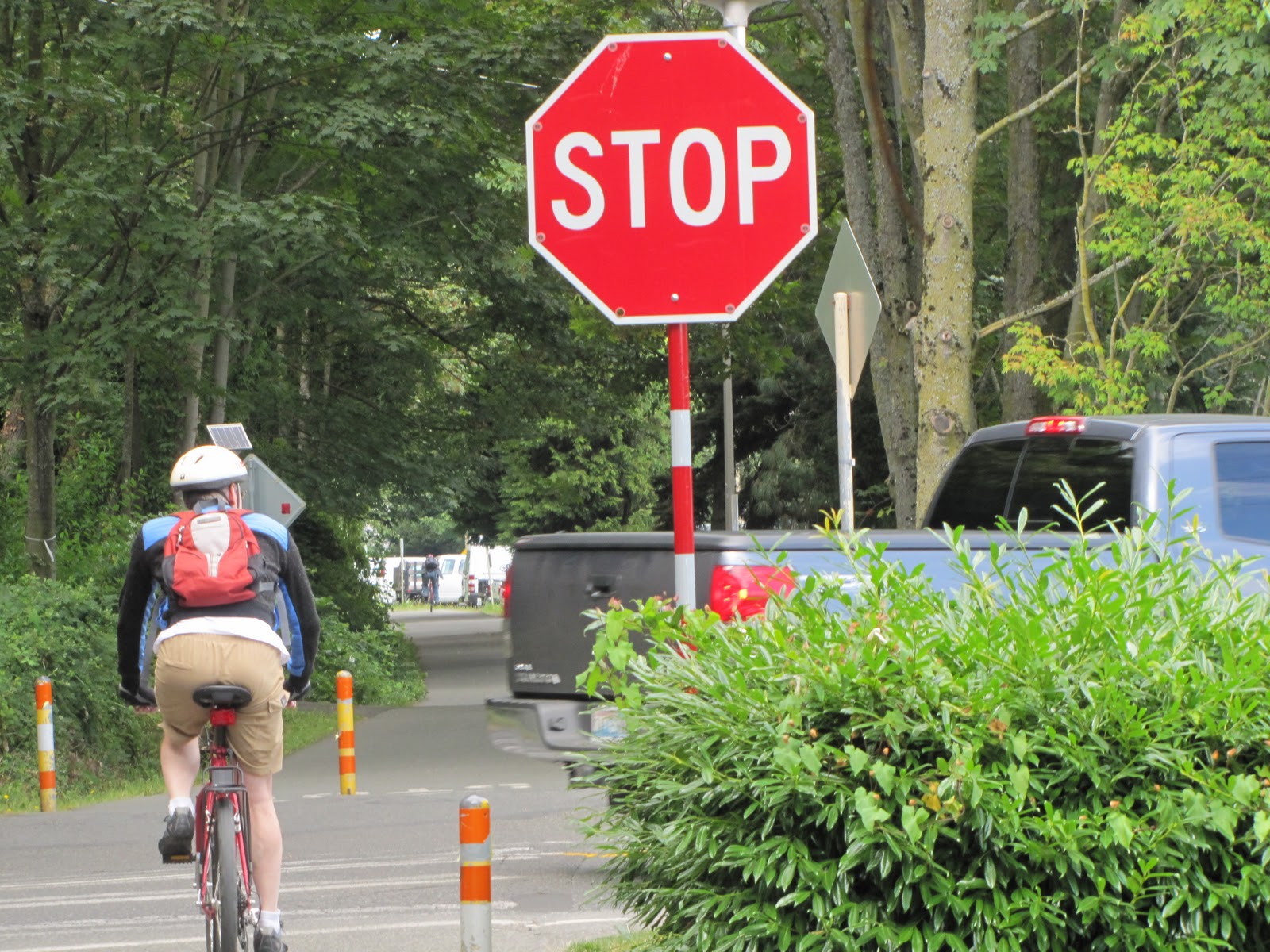
Stop signs: the kudzu of American bike paths


Everyone who’s been to the American South is familiar with kudzu—a creeping plant that appears unbidden, soon covers everything in sight, and serves no useful ecological function
Sort of like stop signs on America’s multi-use bike-pedestrian paths.
This is not a post about how it’s OK for cyclists to run stop signs. And it’s certainly not a rant against stop signs generally. Properly located, they serve a very useful purpose. But in highway engineering as in other aspects of life, too much of a good thing can become a bad thing. And so it is with the stop sign.


In particular, I’m talking about trail builders’ penchant for placing stop signs that purport to require bicycle-pedestrian trail users to come to a halt at every crossing, large or small, significant or not. Certainly it’s annoying. But more importantly, it creates ambiguities about who has the right of way, sows the seeds of confusion for motorists and trail users, and can be downright dangerous. 

What’s more, forcing cyclists to yield the right of way at every crossing violates even America’s auto-centric road engineering standards, and goes against Washington’s traffic laws.

Let’s start with those laws.  Be forewarned, however: Trying to reconcile the Washington statutes that govern right of way where bike-pedestrian trails cross streets may leave you chasing your legal tail. As the Washington Supreme Court once observed, with considerable understatement, “…our state’s laws on bicycles and traffic safety do not present a picture of clarity…”

To begin with, the law considers bicycles to be “vehicles” (RCW 46.04.670), and bicyclists riding on a “roadway” generally have the same rights and responsibilities as car drivers (RCW 46.61.755(1)). Among other things, any “vehicle” that comes to a stop sign must stop and yield to cross traffic (RCW 46.61.190(2)).

So doesn’t that mean that cyclists facing stop signs on a bike-pedestrian path must stop and yield, just as they would as if they were riding on a regular street? Well, not really. 

That’s because of at least two other legal provisions. First, the law requires cars approaching any crosswalk to yield to both pedestrians and bicyclists who are in the crosswalk (RCW 46.61.235). Second, there’s a provision that exempts bicyclists from parts of the Vehicle Code “which by their provisions can have no application [to bicycles].” (RCW 46.61.755(1)).  If cars have to stop and yield to cyclists in a crosswalk, then how can the stop-and-yield requirement apply to the cyclists as well? That would leave everybody and nobody with the right of way.

You also have to go back and ask the question whether a bike-pedestrian path fits within the definition of a “roadway” to begin with, triggering the requirement that cyclists act like car drivers.  In a 1990 case involving a cyclist who was injured in a crosswalk along a King County cycle path, our State’s Supreme Court said no. In that case, which was decided before the legislature changed the law to explicitly require cars to stop for cyclists in a crosswalk, the Court also observed that having different right-of-way rules for pedestrians and cyclists in a crosswalk made no sense.

So what are all those bike-trail stop signs still doing there, anyway? And if a stop sign on a bike trail doesn’t mean what it would if it were placed on a roadway, what—if anything—does it mean? My suspicion is: probably nothing. But no court has ever explicitly said that, although the 1990 Supreme Court case came pretty close.

I doubt that many trail or road users are aware of these legal intricacies, or of the disconnect between the law and the signs. But they must feel the bewilderment in their bones, since the situation on the ground is generally one of mass confusion. Some cyclists, oblivious to their own safety, just blast through the stop signs. Some cyclists prepare to yield to cars, only to have the cars stop for them. Some drivers yield at bike-pedestrian trail crossings regardless of who has the stop sign; others just roar through even if a pedestrian’s in the crosswalk. The end result is danger, since nobody’s sure who’s going to do what.


Aside from the legal confusion these stops signs create, their overabundance of along bike-pedestrian trails violates accepted highway-engineering standards.

Traffic engineers know that if you put too many stop signs where they don’t belong, people—both drivers and cyclists–will start ignoring them.  In fact, the American Association of State Highway and Transportation Officials says that it’s a “misconception” to think that peppering bike trails with stop signs is a good way to reduce crashes. Thus, the national engineering standards that govern such things urge local officials to go easy on the stop signs on bike-pedestrian trails.

The 2009 edition of the Uniform Manual of Traffic Control Devices (the engineers’ bible for such things) says that:  “Speed should not be the sole factor used to determine priority, as it is sometimes appropriate to give priority to a high-volume shared-use path crossing a low-volume street, or to a regional shared-use path crossing a minor collector street.” 

The draft American guidelines for cycling facility design say that “ installing unwarranted or unrealistically restrictive controls on path approaches in an attempt to ‘protect’ path users can lead to disregard of controls and intersection operating patterns that are routinely different than indicated by the controls. This can increase an unfamiliar driver’s risk of collision, and potentially lead to a loss of respect for the [traffic] control…”

So stop signs on bike-pedestrian paths are legally dodgy and can be dangerous. What should be done? Here are a few modest proposals:

–Remove the stop signs.  This one seems obvious.
–Place signs at trail crossings explicitly telling motorists that they must yield to all trail users.
–Amend the law to make it crystal clear that cyclists on bike trails are not subject to the same rules as they are on a roadway.   
–Place “speed humps” at trail crossings to make sure that cars slow down. In the Netherlands, where cyclists almost always have the right of way, it’s common to raise bike trails slightly at road crossings, so that the crosswalk itself is a speed hump. These “raised crosswalks” are starting to appear in America as well. They should be a standard design at all trail crossings that don’t have traffic signals.
–Place traffic signals at trail crossings on busier roads.  That way everybody gets a turn.
–On the busiest crossings, consider bike overpasses, also a common feature on bike trails in the Netherlands, as this video demonstrates. Grade separation is the ultimate safety accessory.

Of course, some will object to what they see as giving cyclists the advantage over “real” transportation.  But the Vehicle Code already gives cyclists the right-of-way in crosswalks, and the signs should be consistent with the law. Moreover the present situation is confusing and dangerous, not only for cyclists but for pedestrians as well.  And the bicycle will never become a viable transportation option for most Americans until those who design bike infrastructure start treating it like one.
·      


Posted in Attitudes, Infrastructure, Issues & Advocacy, Safety, Transportation | 7 Comments

Hub and Spoke: Next stop Everett

This year, thanks to a grant from the Alliance for Biking and Walking, Washington Bikes launched our Hub and Spoke outreach tour.  We have organized meet ups with our members, interested officials, and other community cyclists in Wenatchee, Vancouver and Walla Walla.  (Here’s a link to a previous post about Hub and Spoke.)  Next Thursday, we take Hub and Spoke to Everett.

As the voice for citizens who bike in Washington State, the Bicycle Alliance wants to hear from you.  We want to know what issues you face in your community and we want to hear about local successes.  We also want to share information with you.  We have identified legislative priorities for the 2011 legislative session and we’d like your help to pass them, and we’d like to tell you about some exciting projects that we have coming on line.

Please join us for this timely event if you live in Snohomish County.  We’ll provide light appetizers and a no-host bar is available.  Please RSVP Louise McGrody if  you plan to attend.

Hub and Spoke: Everett
November 18 at 5:30PM
The Anchor Pub
1001 Hewitt Avenue
Posted in Advocacy, Events, Everett | Comments Off on Hub and Spoke: Next stop Everett

Ferries won’t seek to change procedures for bicyclists

Last week, we featured a post about a Washington State Ferry recommendation that would adversely impact bicyclists.  Today’s post is a follow up and comes to us from Gordon Black of Squeaky Wheels.
 

pedbikeimages.org/Carl Sundstrom

For the moment, bicyclists need not worry about any changes to the present system of loading and unloading bikes on state ferries. Washington State Ferries chief David Moseley has stated that the ferry system will not be seeking to adopt a marine industry panel recommendation to load and unload bicyclists after all motorized vehicles. He indicated that a WSF response to the panel’s report (due to the governor and legislature November 15) will simply say that ferry managers will further examine the issue. “We definitely do not want to make any changes at this time,” said Moseley. “I don’t know if these are changes that we would want to make if the structures in place can’t be improved. We want to have discussions with our bicyclist customers to see if collaboratively we can make it better for everyone.”

In a meeting with bicycle representatives November 4 attended by Washington Bikes executive director Barbara Culp and Squeaky Wheels vice president Gordon Black, Moseley was reassuring that on the list of issues facing the ferry system that the bike loading was “not hot.”  Among the panel’s list of recommendations are highly sensitive issues related to crews and union contracts. The bicycle loading issues are, by contrast, relatively low in the hierarchy of challenges the ferry system is facing. State ferries are under financial pressure to cut costs.

Members of the panel drawn from passenger ferry operators around the US visited Washington State this summer and drew up a report issued in early September. It drew a highly critical response from bicyclists, fearful that the present system of three loadings for bicyclists dating to 1999 would be negatively changed. At a meeting called by Squeaky Wheels September 28, some 30 bicycle commuters voiced concerns and ideas to improve safety.

Plan for on-going dialog

The loading issue won’t be back on WSF’s agenda until after the 2011 legislative session, which is scheduled to end sometime in May. In light of the loading issue and on-going problems with space for bikes on the Seattle-Bainbridge ferries, Moseley responded favorably to the idea of setting up a regular forum with bicyclists to discuss all bike-related issues. Details of a future advisory committee on bike issues will be discussed in coming months. Squeaky Wheels will be represented on this new committee – and will be working to protect and promote the interests of bicyclists.

Posted in Advocacy, Commuting, Ferries, Funding/Policy, Guest Blogger, Transportation | 1 Comment

John Streich: Farewell to a Friend

John Streich working at the 2008 auction.

John Streich was one of the first volunteers I met when I joined the Bicycle Alliance staff in 1994.  A friendly and personable guy, John liked to volunteer for things that allowed him to interact with others.  You may have met him staffing our booth at Bike Expo, greeting guests arriving at the auction, or stuffing envelopes at our month end work parties.

John was an adventurous man who led a colorful life.  A technical engineer, he called me one winter to tell me that he needed to back out of a volunteer commitment because he was on his way to Canada to help with avalanche control.  John loved the outdoors.  Besides bicycling, his pursuits included hiking, climbing and sailing.

One of my fondest memories of John was at a volunteer party several years ago.  He was explaining how he had worked aboard a cruise ship one season as a dance partner to single ladies, then demonstrated his dancing skills by dipping a surprised volunteer.

John Streich died last week after a brief bout with cancer.  He will be missed by his friends at the Bicycle Alliance.  Pedal in peace, my friend.

Posted in People, Seattle, Volunteer | Comments Off on John Streich: Farewell to a Friend

Loss of a Champion and the Implications for Bicycling


League of American Bicyclists photo.


While we are all thinking about this week’s elections results, it is hard not to imagine what could be or what will be. One of the saddest losses, while not a Washington State elected official, was that of Representative James Oberstar, a Democrat from Minnesota. He had served 18 terms and was chairman of the House Transportation and Infrastructure Committee. Time and time again he proved to be a tireless advocate for bicycling and walking. Without his efforts, our work to get transportation dollars for bicycling and walking in the Transportation Authorization Bill would have been that much more difficult.

But the one federal program where he really left a legacy is Safe Routes to School. This program, in just 5 short years after its launch, has had a demand much greater than can be funded in all 50 states and the District of Columbia. Washington State Department of Transportaton alone has received millions in federal funding for its Safe Routes to School program, from which countless students, adults, and communities have benefited. It has allowed the Bicycle Alliance, Feet First, Cascade Bicycle Club, and a myriad of state and local agencies, schools and non-profits to develop and sustain many highly successful programs. We are all working towards the goal of changing the habits of an entire generation, as Rep. Oberstar would say.

While it is easy to be saddened by the loss of this champion, let’s look back. What we see is that this isn’t just an issue owned by the Democrats. Our friends at America Bikes point out that under a Republican House, Senate, and White House a lot was accomplished.
“Safe Routes to School and the non-motorized pilot program were created, funding for Transportation Enhancements went up 35% … during one program the annual funding for bicycling and walking went from less than $400 million to more than $1 billion.”
While the economy tells us that funding may be a big issue in the upcoming years, we have a Transportation Secretary by the name of Ray LaHood who, earlier this year, announced that bicycling will be treated as an equal mode of transportation.  We still have supporters on both sides of the isle and will have to work even harder.  So let’s keep in mind that we have a big hill to climb, but we can do it with the help of our dedicated partners.

Posted in Advocacy, Funding/Policy, People, Politics, Safe Routes to School, Transportation | 1 Comment

Ray LaHood on Livable Communities

Grist Magazine has an interesting interview with Transportation Secretary LaHood’s take on livable communities. Highlights for bicyclists include his discussion of growing up riding a bike and being able to bike all over Washington, DC. Then he said:

“On the day that I was going to the streetcar inauguration in Portland, I saw over 200 people at 7:30 in the morning riding their bikes to work. I’ve seen what’s happened here in Washington with walking and biking paths, the biking avenues or lanes that have been created along Pennsylvania Avenue, along 14th street and 16th street. It’s what Americans want.”

The Secretary of Transportation is aware that people are increasingly interested in bicycling and alternative infrastructure.

“I think we’ve sent a pretty loud message that one of our signature transportation programs will be livable and sustainable communities. … [These programs are] not going to go away, not because of Ray LaHood or because of Barack Obama, but because this is what people want. Once politicians begin to learn that, they begin to adopt the idea that these are good opportunities for their constituents and for Americans.”

Now, throughout the interview, LaHood emphasizes walking and biking paths rather than friendlier streets. However, the shift of focus from building more motor vehicle infrastructure to thinking about what makes a community pleasant to live in bodes well for our future. It’s our responsibility as informed citizens to let our politicians know that we care about the communities we live in. That’s just one reason I hope you did your homework and voted. For the rest of the year, your support for the Bicycle Alliance means that we can continue advocating for the kinds of changes Secretary LaHood supports.

And, for those of you who feel extra concerned about the safety of any new infrastructure, there’s the airbag bike helmet.

Posted in Attitudes, Complete Streets, Infrastructure, Transportation | Comments Off on Ray LaHood on Livable Communities