Rumbling about rumble strips pays off
As a bicycle advocate, I’ll take every victory I can get and one just crossed my desk. But first the back story…
In May, my phone rang with this admonishment, “Rumble strips are being cut into the shoulder of SR 525 on Whidbey Island right now! What’s going on and what are you doing about it?”
Yikes, and I was just talking with Adventure Cycling Association’s National Bicycle Routes staff about Highway 20 as a Washington treasure. I hopped on my trusty bicycle, loaded up my panniers and headed south on Whidbey Island with my husband Andy. We rode for the next two days crying in frustration and anger to see rumble strips carved into the shoulders of a premier cycling route.
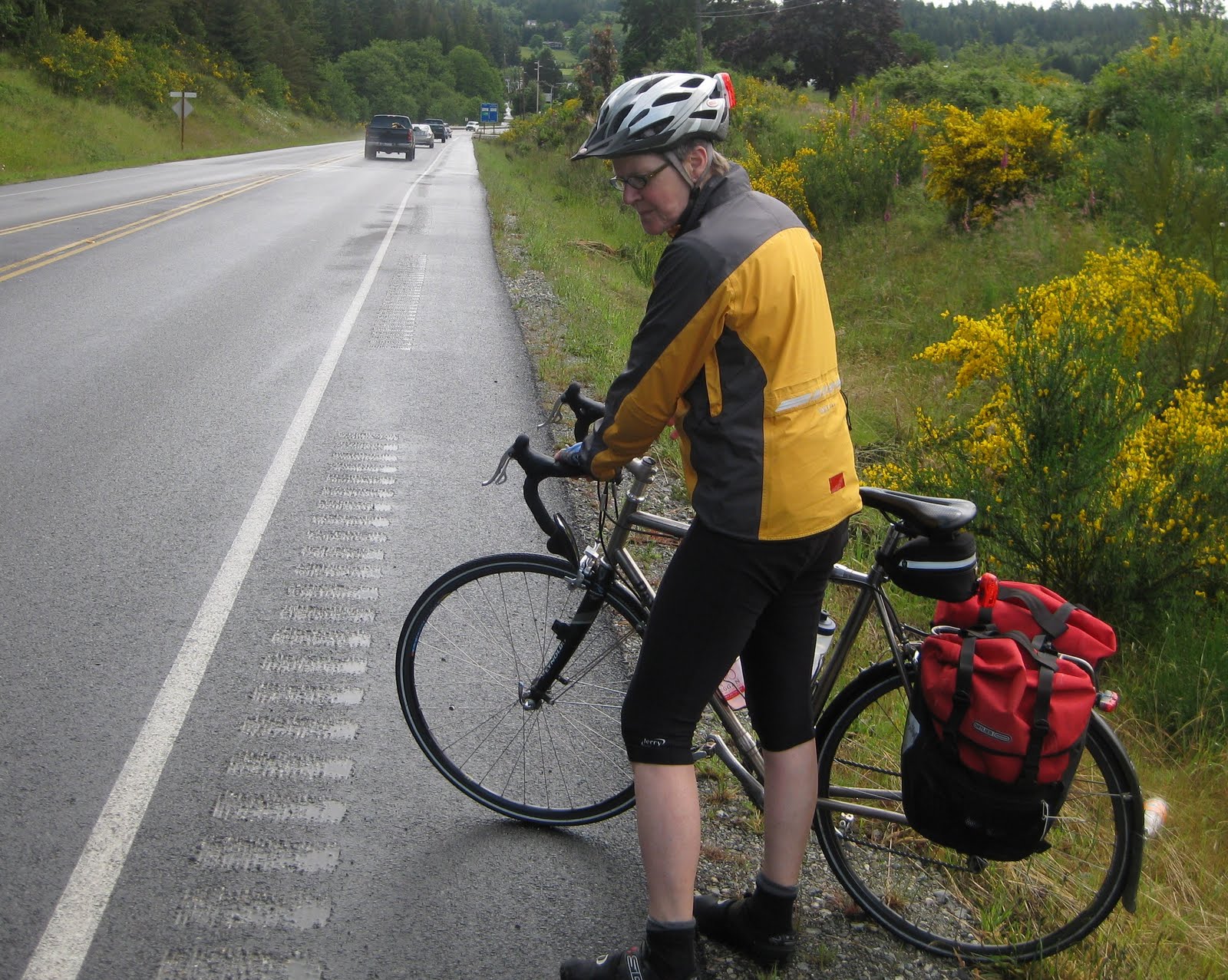
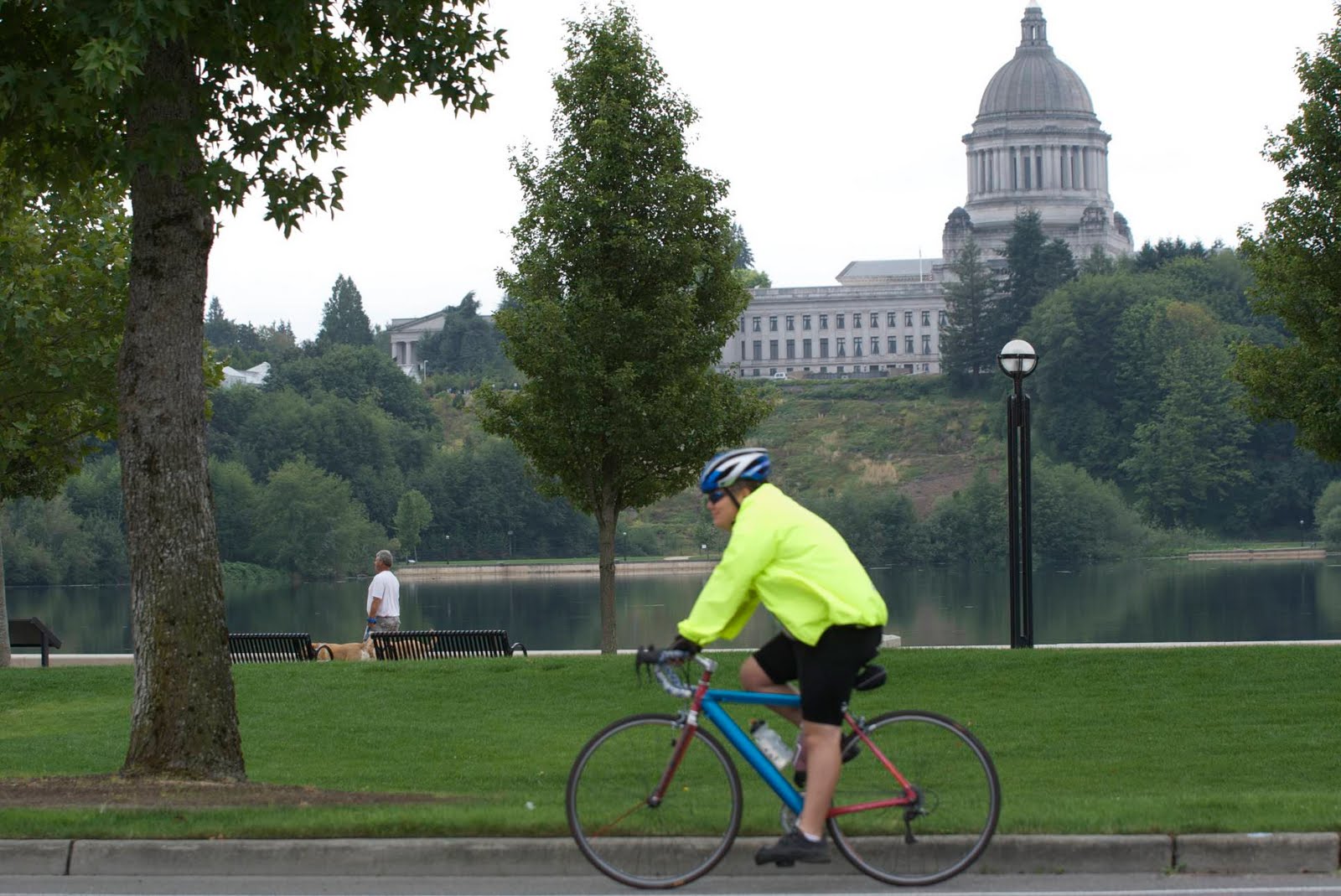
Upon returning home, I armed myself with this picture and headed to Olympia confident but very unhappy that rumbles had been cut seemingly without regard to Washington State Department of Transportation (WSDOT) guidelines.
I met with Transportation Secretary Paula Hammond and two of her staff: the WSDOT Bicycle and Pedestrian Coordinator and the person from WSDOT’s Design Office responsible for writing the Design Manual. I explained what had happened and showed them the photo. I asked that the Design Manual be amended and updated, and I asked for an evaluation of the rumble strip installation on Whidbey Island. That was in June.
Now, in July, some good news! An evaluation by WSDOT headquarters staff validated my appraisal that rumble strips on SR 525 were incorrectly installed along guardrails and other locations, and will be paved over later this summer–SUCCESS! Rumbles on SR 20 were also incorrectly applied and will be paved over next summer–PARTIAL SUCCESS! Changes were made to the Design Manual regarding outreach–MINOR CREDIT! More work needed.
Is it a victory that I rode the length of Whidbey Island in the rain with my crabby husband to tell WSDOT that they had done something incorrect and unnecessary? That rumbles affect bicycle safety and interstate tourism? I’ll claim the victory when rumbles are used sparingly for the safety of all roadway users. Watch for action alerts as the Bicycle Alliance plans to act proactively to stop this type of installation.
*******************************************
What’s a rumble strip and why should I care?
If you ride on city streets or county roads, chances are you won’t ride across rumble strips. However, anyone out riding the highways and byways of Washington for recreation, health and happiness should care because a safety feature for motorists can create a serious safety hazard for cyclists.
To paraphrase the US Department of Transportation a shoulder rumble strip is a “longitudinal design feature” which is a series of indented cuts in pavement intended to alert inattentive drivers through vibration and sound that their vehicles have left the travel lane. For more info, check Federal Highways Administration’s Rumble Strips FAQ.
The Tour de Fat Experience
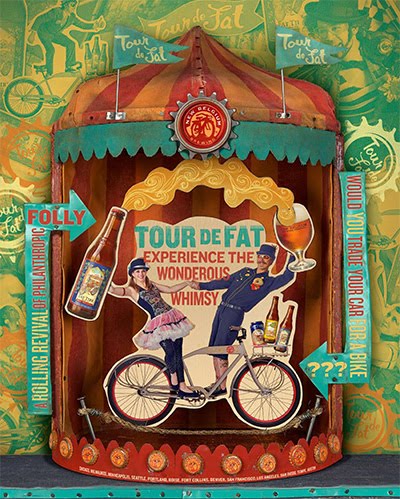
Decorate your bike and don your alter ego…Tour de Fat is returning to Seattle’s Gasworks Park on July 31!
Tour de Fat is not a bike ride or race. It’s a celebration of all things bicycle organized by our bike-loving friends at New Belgium Brewing Company. This rolling carnival travels to select communities around the West and features a costumed bike parade for the young and young-at-heart, music and other live performances, a car-for-bike swap, beer garden, and food vendors. All this wacky fun and goodness benefits the work of the Washington Bikes and Bike Works – woo-hoo!
The event kicks off in the morning with the bike parade ($5 suggested donation for this event benefits Bike Works). Costumed participants will meander from Gasworks Park through Fremont, the self-proclaimed center of the universe, then roll back to the park for the festivities.
Kick back and listen to the bands, be entertained by performances, and sip some tasty New Belgium beers (these proceeds benefit the Bicycle Alliance). Test ride one of the many bike contraptions in the bike pit (the bike with sneaker wheels is a popular one). Sign up for the Slow Ride contest—slowest rider wins! And be sure to bring an old bike tube to contribute to Alchemy Goods recycling bin. You’ll be eligible for a drawing for some of their cool products made from recycled bike tubes and other recycled materials.
Celebrate the bicycle as a sustainable and worthy form of transportation with the announcement of the car-for-bike swap winner in the afternoon. (This could be you if you enter the contest now!) The lucky winner is transformed before all from a car driver to a full-time bike commuter when he/she hands over their car, title and keys in exchange for a tricked out custom commuter bike.
Admission to Tour de Fat is free, but bring cash in your wallet. Proceeds from the parade, Tour de Fat merchandise, and beer sales benefit bicycle advocacy. After all, it is all about the bicycle!
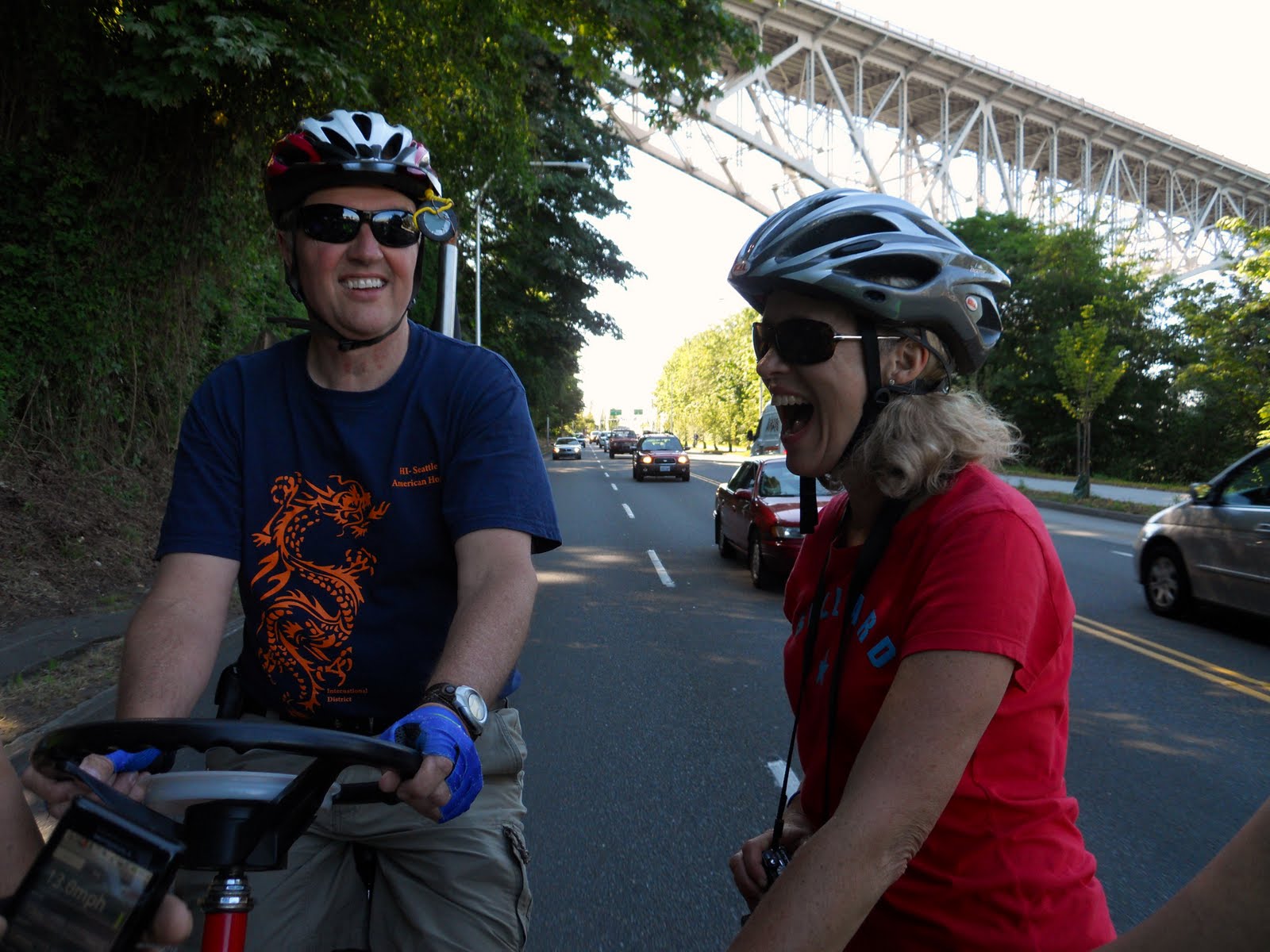
Tour de Fat poster image courtesy of New Belgium. Bike parade and contraption images courtesy of Carla Gramlich.
A tragedy in Cheney and the “right” to drive
Why I Love the Bicycle Alliance
Nonprofits seem to operate in their own strange sphere in the world, some alternate reality that for-profit and governmental agencies remain almost entirely unaware of. It has taken me quite a while to figure out how to live in this parallel world; maybe the air is more rarefied, or the water a little bit purer, or the nutrients a bit more nutritious. Whatever the reason, I found myself slowly adapting to my new environment. Now, after 6 months with the Bicycle Alliance, I think I can quantify what I’ve come to appreciate about working there.
- Diversity. “What?” You may ask. “How can you say ‘diversity’ in an organization run almost entirely by white, middle-class baby-boomer women?” It’s true that if you take a superficial look at the Bicycle Alliance’s staff, it does seem to lack a certain breadth or depth. Yet each of the staff brings her (or his) own experiences to the organization and those contributions run the gamut. Name it and one of our staff people has probably done it.
Additionally, the diversity of people who walk in the door astounds me on a daily basis. I’ve started saying “You never know who’ll walk in,” and it’s true — working in Pioneer Square means interacting with everybody from homeless men to hot-shot tech people to everything in between. The vibrancy, the life, the variety of perspectives continually astound me.
- Passion. It’s quite true that people don’t work at nonprofits for the money. You have to truly care about the nonprofit’s mission in order to stay and succeed. At my old corporate job, we had no common bond, aside from “It pays the bills.” At the Bicycle Alliance, when we sit down for lunch together, we all have the shared love of bicycling drawing us together. Regardless of our differences, we all firmly believe in the importance and value of bicycles as a transportation option in the future, and we believe in making that a reality.
- Cool. I mean cool in the relaxed sense, the hakuna matata sense, the sense that although we’re all working hard to achieve important goals, we aren’t killing ourselves along the way. It means we’re taking time to go for a bike ride on a sunny day. It means that timing vacations just right isn’t really that important, but that having a relaxing time and coming back rejuvenated is. It means that I know if I wake up one morning and cannot drag myself in for love or money, that’s OK. Nobody’s going to flip a lid because I didn’t show up. It means that we’re having a favorite cinnamon roll contest and everybody will bring in a delicious offering. It means we can take time for personal concerns and not worry about an angry boss looking over our shoulders. It’s working to live, not living to work.
Those are just a few of the reasons I love the Bicycle Alliance. I’m not sure how I’ll go back to working a boring, cubicle-bound corporate job after my AmeriCorps tenure ends. Fortunately, I’ve learned another beautiful thing about nonprofits, which is summed up neatly in this exchange from Shakespeare in Love:
Philip Henslowe: Mr. Fennyman, allow me to explain about the theatre [my note: read “nonprofit” here] business. The natural condition is one of insurmountable obstacles on the road to imminent disaster.
Hugh Fennyman: So what do we do?
Philip Henslowe: Nothing. Strangely enough, it all turns out well.
Hugh Fennyman: How?
Philip Henslowe: I don’t know. It’s a mystery.
2011 Legislative Priorities
A big part of Washington Bikes’s mission is working in the State Legislature to make Washington state even more bike-friendly. Washington has been named the “most bike friendly state” three years in a row (the only state to ever be #1) by the League of American Bicyclists, but we all know there is more to be done to make our communities welcoming to everyone who might ride.
On June 12th, the Bicycle Alliance Legislative and Statewide Issues Committee met to set our priorities for the 2011 Legislative Session for recommendation to the full board. Committee members represent bike clubs and interests from around the state. We had at least nine counties and almost as many bike clubs represented. Many views and interests were expressed, but we came to agreement around:
Mutual Courtesy and Safe Passing Act. This bill would enhance the existing requirement for drivers to pass bicyclists safely and include other needed clarifications on bike-car interactions.
Share the Road bicycle and pedestrian education added to traffic school curriculum. This bill is modeled after the law the Bicycle Alliance got passed requiring all driver education schools in the state to teach a bicycle and pedestrian awareness curriculum.
Authorizing lower speed limits. By allowing cities and counties to adopt lower speed limits it would decrease bicyclist and pedestrian injuries and fatalities. Currently, lower limits can only be specified for school and construction zones.
Directional signs and bike maps are considered advisory. Motivated by Pierce County saying they’ll no longer publish a bike map due to a lawsuit by a cyclist injured while following a route, we want to protect both cyclists and the expansion cycling information and visibility.
Complete Streets grant program. Jurisdictions that have complete streets policies would be eligible to apply for state grant funding for implementation. This bill is another carryover from 2010, an effort led by Washington Bikes and Transportation Choices Coalition, among others.
Vulnerable Users. This would create an enhanced penalty if a pedestrian or cyclist (or other vulnerable roadway users) are killed or seriously injured by a motorist who violates a traffic law (such as failing to yield the right of way or speeding). Cascade Bicycle Club is the lead on this effort, and we are already working again to support it.
We’ll be keeping an eye out on the Safe Routes to School program making sure the community demand for grants and safe places to walk and bike is considered and that hopefully funding is increased when budgets and bills are written. The Bicycle Alliance will also work with other stakeholders to revise the Cost-Benefit law for transportation investments and a transportation funding package with significant investment in alternative transportation modes.
The Bicycle Alliance has a decades-long history of success in Olympia. The credit goes to our members and supporters who help give a bicyclists and potential bike riders a voice when laws are written.
Use this link to learn more about our priorities.
Teaching Safe Choices
I started to write a long post about bicycling safety. It included lots of statistics, facts, and figures. Ultimately, though, I found it very difficult to write about staying safe on a bike. When it comes to defining “safe,” you’ll get as many different definitions as people you ask.
Remember when your mom or dad taught you to ride a bike and told you “Only ride on the sidewalk”? Many adult bicyclists still adhere to that advice in the mistaken belief that it’s safer on sidewalks.
Remember how your running coach always told you to run against traffic so you could see cars coming? Adult cyclists want to see what’s coming, too, and ride the wrong way against traffic in a mistaken belief that’s safer than having cars approach from behind.
Remember how as a pedestrian you could, at opportune moments, ignore the signal and dash across the street real quick with no negative repercussions? Even more than pedestrians, bicyclists hate having to slow or stop, and many blatantly run stop lights (not to mention stop signs!).
People firmly believe that these activities really are safer.
My question (questions, really) for you, then, is this: How should we as informed bicyclists respond in these situations? A very few bicyclists engaging in dangerous and rude behavior makes bicycling less safe for all of us. Do we have a responsibility to educate misinformed bicyclists as we see them putting themselves in danger? Is there a way to do this effectively, without sounding like an obnoxious know-it-all? Is it possible to improve safety and enjoyment for bicyclists and motorists alike through on-the-spot education?
Or must we simply fall back on the truth that the only person you can control is yourself?
They’re on the Road
Yes, it’s been cold and wet this spring. Yes, it’s sometimes intimidating. Yes, it’s hilly in Seattle. But there’s lots of folks on the road. In the course of a couple of days I stopped at…


.jpg)