Hood Canal Bridge to Get Safer Bike Lanes…But Not for Awhile

This post was written by our guest blogger Doug Cantwell of Seattle. 
 
Bad News: The Hood Canal Bridge bike lane presents a hazard to cyclists.

Good News: WSDOT has announced plans to refit the grated section of the bridge with a wider, safer bicycling surface.

The Catch: It won’t happen overnight.

Photo:  Dana Berg/Squeaky Wheels
When the new, improved Hood Canal Bridge reopened in June 2009, bicyclists were disappointed—some say appalled—to find the same narrow steel plating laid across the grated section for their use that they’d come to fear and loathe on the old dilapidated bridge. 

The majority of the floating structure offers a generous 8-foot-wide lane, but on the grated section, cyclists must negotiate a 3-foot-wide steel plate that is further reduced in effective width by fasteners to about 18”.

“It’s pretty scary,” said Barbara Culp, executive director of the Bicycle Alliance. “If you’re carrying panniers, it would be easy to bump them on the railing, careen off onto the bare grating and go down hard.”

Barb reported that the narrow plate has caused a half-dozen spills—none of them serious—in the two years since the reopening, but she considers it “a major accident waiting to happen.”
Under pressure from the Bicycle Alliance, Port TownsendBicycle Association, West Sound Cycling Club and Squeaky Wheels (a Bainbridge Island cycling advocacy group), WSDOT recently announced plans to refit the narrow plating with a 5-foot-wide usable surface. Federal and state funds totaling $1.3 million have been allocated for the project.

However, the state won’t be accepting bids for the work until 2012. So until the contractor gets hired and the new plate is installed, let the bicyclist beware…!
Posted in Advocacy, Bike Clubs, Guest Blogger, Infrastructure, Kitsap County, WSDOT | Comments Off on Hood Canal Bridge to Get Safer Bike Lanes…But Not for Awhile

Ten lessons for a vibrant city

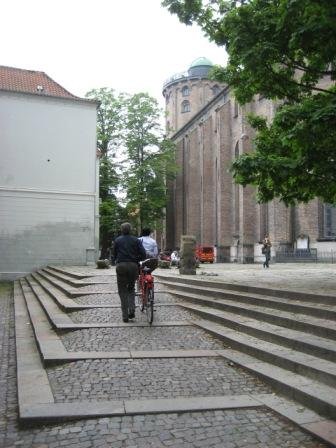
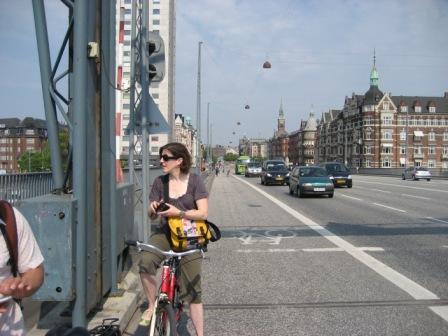
Even though I’ve been back in Seattle for a week, my head and heart are still in Copenhagen, Denmark where I attended a study tour underwritten by the Scan/Design Foundation, and lead by i-Sustain . The weeklong tour was a guided whirlwind of the best bicycling practices in a city known for its world-class bicycle facilities and biking culture.

10 Lessons learned from the seat of my 3-speed red rental bike:

1) Think out of the car and beyond the oil barrel to energy independence. Denmark began planning for bikes, buses, trains, and subways during the oil crisis in the mid 1970s.

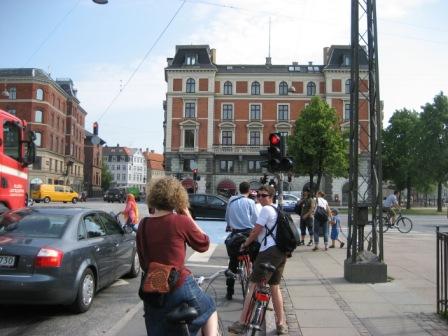
2) Really, truly you can share the road, and do so safely. It’s about planning for “soft traffic” which means giving bike riders and pedestrians separate facilities–sidewalks and cycle tracks that get a “green” traffic signal before motorists.

3) Think beyond money. Envision a vibrant, vital city which embraces biking as an inexpensive transportation option.

4) Arrive by bike, bus or train. When I asked a city employee how he got to the meeting, he replied, “by bus, we’re not allowed to drive to meetings.”

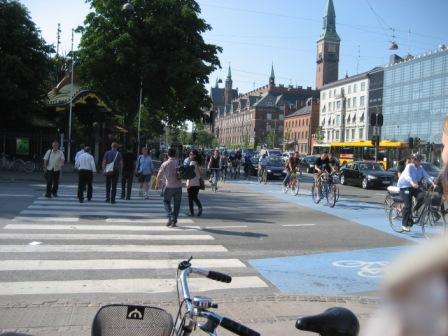
 5) Separated facilities have fostered a 37% bicycling rate. Cycle tracks are a separate facility running on all major roads in Copenhagen. They parallel sidewalks, and traffic lanes. They have fostered a main street atmosphere with reduced noise levels.

6) Blue lanes through intersections coupled with a green light ahead of motorists has reduced traffic conflicts and collisions. The lanes clearly show the bicyclist where to ride, and gives motorists a visual cue to watch for both people on bikes and on foot.

7) Biking skills are taught to every school child. Red Cross and other non-profits teach bicycle skills to immigrants. Copenhagen is planning for a 50% bike ridership by 2015.

8) No lycra–just people riding in jeans, skirts, shorts, suits, dresses.


9) Offer options: not everyone wants to ride on the cycle tracks. Denmark doesn’t have steep hills but they do have open minds about providing options over and around obstacles.

10) Cycling should be as easy as walking. I’m still processing what I learned; the study tour was an eye-opening experience. I’ve changed my thinking and I’m committed to working with my study-tour colleagues to bring some of these best practices to Seattle and other Washington cities.

Posted in Accessibility, Advocacy, Attitudes, Bike Culture, Complete Streets, Education, Funding/Policy, Go By Bike, Infrastructure, Safety, Share the Road, Transportation | Comments Off on Ten lessons for a vibrant city

First Thursday ArtWalk at the Bicycle Alliance

This post was submitted by JoAnn Yoshimoto, our Development Director.

Scores of bicycle enthusiasts gathered on June 2 for the First Thursday ArtWalk at the Bicycle Alliance office in Pioneer Square.  On display were the creative works of members Lisa Reynolds (encaustic and mixed media), Marie Zahradnik (pencil and watercolor), Andy Goulding (pen and ink), and Michael Stearns/Erica Hanson (waxed canvas). To the delight of guests, Marie Zahradnik drew “blind contour portraits” – created with the artist looking at the subject but not the paper. She also hung the new unofficial emblem “In Bikes We Trust.”
Join us on Thursday, July 7 for the next ArtWalk at the Bicycle Alliance. Several new artists/members will be featured. As a bonus, Marie and Andy plan to return in July and sketch portraits for guests who are interested in being immortalized in an original work of art!
Posted in Events, Guest Blogger, People, Seattle | Comments Off on First Thursday ArtWalk at the Bicycle Alliance

Bringing Bicycle Safety Education to Washington Schools


It’s been a busy spring for our Safe Routes to School staff.  Trainers from the Bicycle Alliance and Feet First trained 40 educators from eight school districts how to teach safe biking and walking skills to their students.  This curriculum will be taught in grades 5-8 physical education classes.
 
School districts that received training this spring include Sedro Wooley, Lynden, Eatonville, Zillah, Wahluke, Waitsburg, Pomeroy and Reardan-Edwall.  Additional trainings are scheduled later this year, and up to 29 school districts can be trained in total.  This map shows the school districts that have been awarded training so far.
This training project is funded by a two-year grant from the Washington State Department of Transportation, and managed by the Office of Superintendent of Public Instruction.  If your school district is interested in applying for a training grant, please visit OSPI>Safe Routes to School Program.  Applications are accepted on a rolling basis throughout 2011.
Posted in Education, Kids, Safe Routes to School | Comments Off on Bringing Bicycle Safety Education to Washington Schools

Bike Alliance Statewide Legislative Committee Set to Meet June 25 at REI Headquarters in Kent to Discuss 2012 Legislative Priorities

Please RSVP If You’d Like to Attend and Share Ideas


Question: What do cycling advocates do right after the state legislature’s annual session comes to a close?  Answer: Start planning for next year’s session.

The job of setting policy priorities, crafting legislation and building support for its passage starts months before the legislature’s opening gavel in January.  

The Bike Alliance will begin that process for next year’s session on Saturday, June 25,  from 10 a.m. – 2 p.m., when its Legislative and Statewide Issues Committee meets at REI Headquarters, 6750 South 228th Street in Kent. Anyone who is interested in bicycle advocacy is welcome to attend the meeting and share ideas. However, because the meeting will be held at REI’s offices during non-business hours, those who wish to attend should RSVP in advance by contacting Bike Alliance Executive Director Barbara Culp at barbc@bicyclealliance.org.


The Committee, which acts in an advisory capacity to the Bike Alliance’s board, is made up bike-club representatives and other appointed individuals from around the state.  The Committee’s current membership includes cyclists representing clubs from Spokane to Vancouver, from Bremerton to Walla Walla and Wenatchee, and from Yakima to Snohomish and Skagit County.  The Committee’s charter calls for two formal meetings a year; committee members also hold periodic telephone conferences during the legislative session.

Under the charter, the purpose of the June meeting is to “develop a list of legislative and advocacy matters of statewide significance to be pursued in the subsequent year as a recommendation to the Bicycle Alliance Board.”  Among other things, this year’s meeting is likely to include discussion about whether to pursue three bills backed by the Bike Alliance that failed to make it through the 2010 session. They are:

·      HB 1217, which would have given cities broader authority to set 20-mph speed limits on non-arterial streets.

·      HB 1700, which would have allowed greater design flexibility to encourage construction of higher-quality cycling and pedestrian infrastructure.

·      HB 2053, which would have increased some Department of Licensing (DOL) fees, with a part of the new money to be earmarked for the “Safe Routes to School” program.

HB 1018, the Mutual Responsibility bill, was tabled at the Bike Alliance’s request and will not be re-introduced. Shortcomings in the bill were identified during this year’s legislative session despite previous widespread outreach and input on the measure, which three years earlier had started as the “3-foot passing” bill.  Components of the bill that have value and those that are of concern will be discussed at the June 25 committee meeting.   Some elements of the bill may be included in a future legislative proposal; however, the Bike Alliance does not intend to reintroduce any such bill during the 2012 legislative session.

Committee members and other participants may also bring new proposals for discussion by the group.

If you’d like more information about the Committee and its work, you can visit the Legislative Issues page on the Bike Alliance’s website, at http://www.bicyclealliance.org/programs/legislation.html.  That page includes a link to some of the Committee’s past accomplishments.

Posted in Advocacy, Issues & Advocacy, Politics | Comments Off on Bike Alliance Statewide Legislative Committee Set to Meet June 25 at REI Headquarters in Kent to Discuss 2012 Legislative Priorities

Bicycle Haiku

Bicycle kanji

A few months ago, just for fun, I posted a bicycle haiku that I had written on the Bicycle Alliance’s Facebook page:

With tailwind and smile
I roll through many landscapes.
My bike sets me free! 

Then I invited our Facebook friends to share their own bicycle haiku, and they did!  Here are a couple of them:

Fresh smooth roadway calls
Tires gliding soundlessly
Speed and balance sweet.
– Anthony Medina 

li’l stardust rider
swaying with each pedal stroke
six-year-old freedom.
– Claire Petersky

I quickly discovered that bicycle haiku, or baiku as it is sometimes called, is a popular subset of this poetry form and there are websites dedicated to it.  For instance, there is the Baiku blog written by a cyclist and poet in Portland.  A website called Bike Reader has a page dedicated to bicycle haiku and contains over a hundred bicycle haiku submissions.

Now, dear cyclist, it’s your turn to spin your creative wheels as I invite you to submit your own bicycle haiku.  Please follow the standard haiku form of three lines–5 syllables, 7 syllables, and 5 syllables.

Posted in Bike Blogs, Bike Culture, Humor | Comments Off on Bicycle Haiku

Bicycling Zen and the Irate Motorist Syndrome

A hundred-mile ride sounds inconceivably long to most people, and when I think about it rationally, it seems impossible. But when I get out there to do a century, I don’t watch my odometer and spend the whole time calculating miles left — that leads to madness. Instead, I find myself in this quiet place where I’m just focused on hanging on to the wheel in front of me, the feel of the wind and sun on my skin, the air in my lungs, the next pedal rotation. Eating. Drinking. Shifting. The next hill. Simple things.

I don’t worry about the next fifty miles; they’ll take care of themselves. Instead, I focus on the next fifty feet. I pace myself. If I’m riding hard, time contracts to a point. Every moment I have the opportunity to choose: Keep pushing, or let go? Every time I choose to continue to push hard, I triumph.

Every mile traversed is a blessing of quietness in my mind. In those miles, I’m not worrying that I don’t have a job or any good job prospects. I don’t worry that I’m wasting my days. I don’t worry about money, house maintenance, what we’re having for dinner, or being alone most of the time.

It’s a mental stillness that I can never achieve anywhere else. It’s beautiful.

Then somebody drives by and honks, shouting, “Get off the road!” If I’m lucky they confine themselves to that kind of polite and misinformed ejaculation. More likely, they’ll lace their comments with profanity and a one-fingered salute, just in case I didn’t get the point. Usually, thank goodness, the wind whips away most of those nasty shouts, so I don’t have to hear the details, just the tone.

I know that bicyclists do plenty of things to earn motorists’ animosity. I’ll be the first to admit that I’m guilty of plenty of egregious on-bike law-breaking myself, especially when riding with a group. But often enough, I’ll be doing something innocuous — riding alone along on the other side of the road; riding in a group single-file in the shoulder — and BAM! Irate Motorist Syndrome strikes. It’s road rage, but magnified. Even if I am doing something wrong, does that make it right for the Irate Motorist to retaliate? If you see somebody in a car run a stop sign, does that make it OK to chase him down, honking and flipping him the bird? No.

What is it about my being on two wheels that makes it acceptable for a stranger to come up and shout red-faced profanities at me? If I cut in the grocery line, would the same person walk up and start screaming swear words at me like that? No. If I cut into a lane on the freeway rudely, would he lay on the horn that hard, that long? Not likely. It’s as if because I’m on a bike, and the motorist has seen bicyclists doing things he hates, that makes it OK to take out all his vitriol on me, regardless of my own behavior.

I continue to be saddened by these interactions. We Americans have an amazing system of beautifully-paved asphalt roads that are a boon to motorists and bicyclists alike. I wish we could overcome our selfishness, our impatience, our busyness — all those things that contribute to anger, us-versus-them, and hatred — to be able to both courteously share use of the amazing infrastructure available to us.

Meanwhile, I’ll continue to seek the peace of two-wheeled zen. And I’ll continue to smile and wave at angry motorists. If you see me on the road, you’ll know me by my two white streamers on my helmet. Think about driving by with a word of encouragement. I could use it. After all, odds are I’ve ridden over fifty miles, and have as many more still to go.

Posted in Adventure, Attitudes, Share the Road | 2 Comments

We’re Hungry for Good Urban Public Space

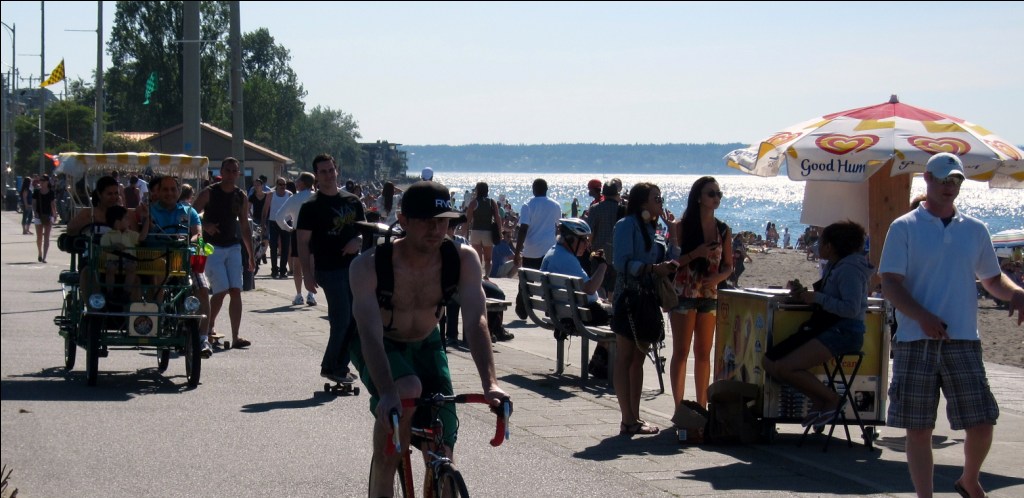
Seattle’s Alki waterfront…a welcome dose of sunshine…near 80 degree temperatures. These elements converged last Saturday and people came out in celebration. Lots of people. The West Seattle Blog wrote about it here.

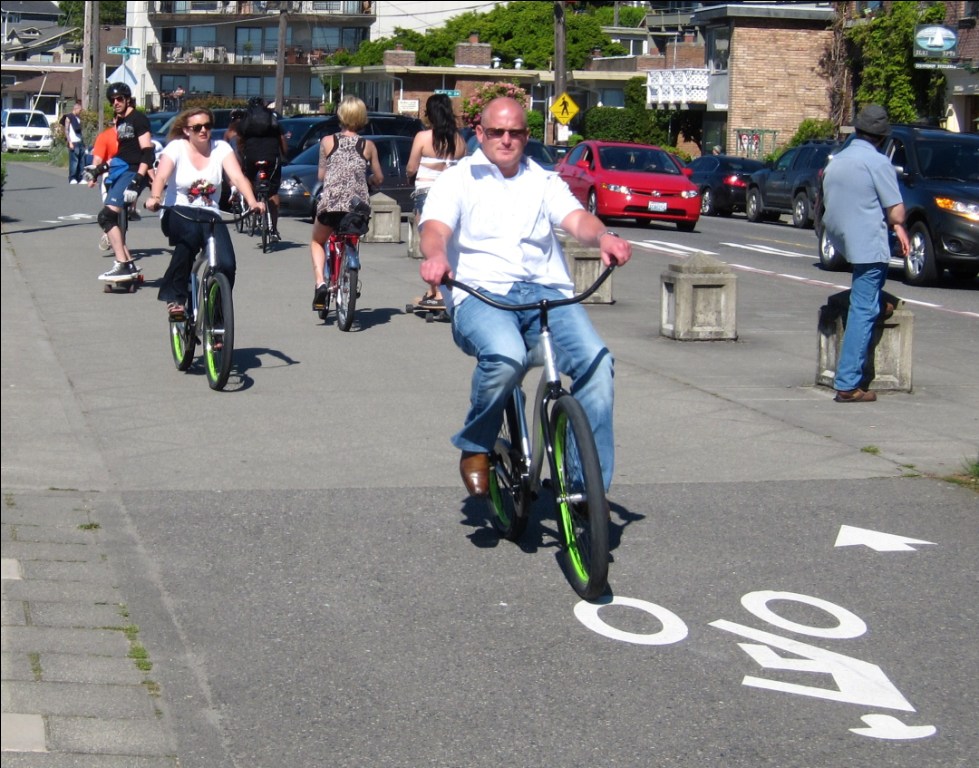
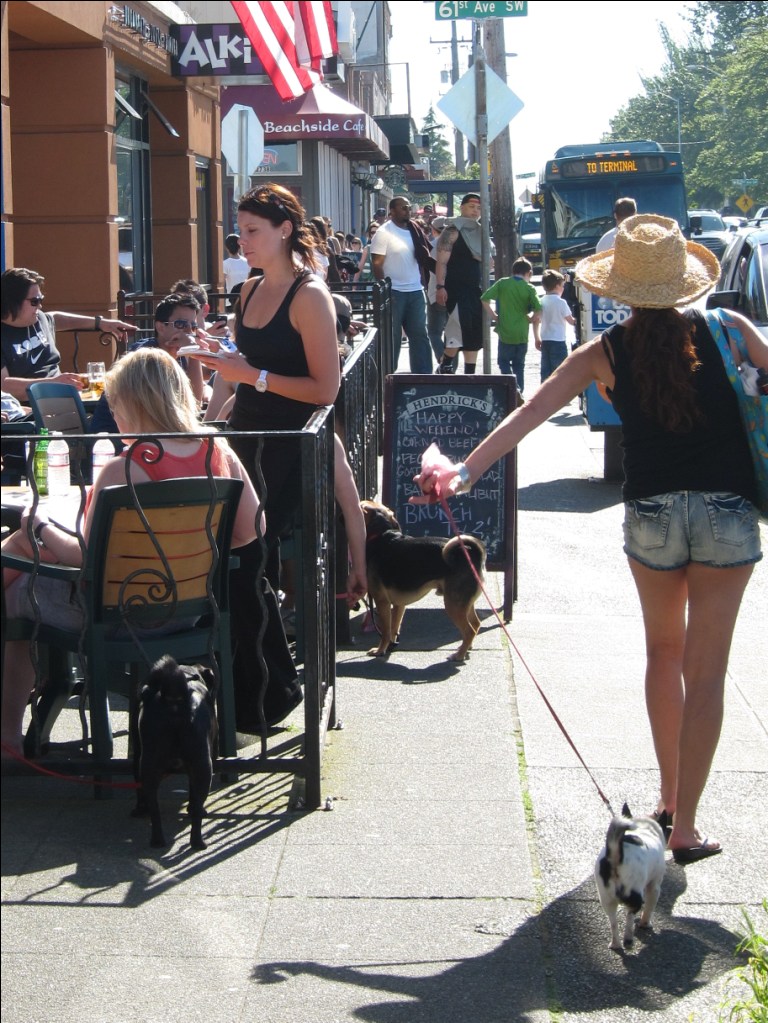
Alki is a wonderful public place. It has a sandy beach, waterfront trail, restaurants and cafes, views of the Olympics and Seattle, and offers some of the best people watching. Alki has something for almost everyone and is well used public space.  And it’s the kind of environment that encourages physical activity–walking, biking, skating, dancing, volleyball, swimming, and more.

Wouldn’t it be great if we had more public spaces as inviting as Alki? Some communities are trying to reclaim public space for greater use by people—even if it’s only temporary. Ciclovias temporarily close streets and reclaim them for use by people to gather, walk and bicycle. Some Washington communities are holding ciclovia events and you can read a blog post about it.

Some forward thinking folks view Ciclovias as a tool for urban planning. These events invite citizens into their own streets and gives them a different view of their city and the concept of public space. Ciclovias demonstrate the importance of incorporating physical activity opportunities into our public spaces and built environments. And, in comparison to major infrastructure projects, ciclovias are cheap. You can read a post from the Project for Public Spaces blog about this movement.

Posted in Accessibility, Attitudes, Infrastructure, Seattle, Sustainable Living | Comments Off on We’re Hungry for Good Urban Public Space

Coming to a City Near You: Car-free summer events


What happens when you take cars off the streets for awhile?  Folks come out to bike, walk, skate and socialize with each other!

Ciclovia (Spanish for bike path) refers to events that temporarily close streets to vehicle traffic, turning them into public space for people.  Bogota, Columbia, the city that pioneered the Ciclovia movement, has closed streets to cars every Sunday since 1976.  People of all ages and classes pour into the streets to do everything except drive.  Watch a video on Ciclovia in Bogota.


Ciclovia style events are appearing in US cities, including communities in Washington.  Seattle Summer Streets are car-free events scheduled in four different neighborhoods.  The city also closes a portion of Lake Washington Boulevard to vehicles most Sundays between May 1 and September 25 for Bicycle Sunday.

Spokane is bringing its SummerParkways to three neighborhoods, one of which will be an evening event.  Four miles of roadway will be closed and citizens are encouraged to come out for fun and physical activity.

Although Vancouver does not organize a car-free event, folks can head across the Columbia River and experience Portland’s Sunday Parkways.  Five parkway events are planned in different neighborhoods throughout the summer.

Folks in Tacoma can have a car-free experience every weekend. Five Mile Drive in Point Defiance Park is closed to vehicular traffic every Saturday and Sunday morning until 1PM.  Details are here.

Did I overlook a ciclovia event in your community?  Please share the details with us.
Posted in Accessibility, Bike Culture, Events, Health, Seattle, Spokane County, Tacoma, Vancouver | Comments Off on Coming to a City Near You: Car-free summer events

Hub & Spoke: Next Up is Spokane

Hub & Spoke, the Bicycle Alliance’s community outreach tour, heads to the Steam Plant Grill in Spokane on June 23.  This event is part socializing and networking, and part presentation and discussion.

“As a statewide bicycle advocacy organization, we have a duty to meet with cyclists regionally in their communities,” stated Executive Director Barbara Culp.  “Hub & Spoke is the perfect outreach event for us because we build in social time with the business.”

The business part of the evening begins with a brief round of introductions, followed by a progress report from the Bicycle Alliance.  This includes a recap of how cyclists fared in the legislative session.  Ian Macek, WSDOT Bicycle-Pedestrian Coordinator, will be on hand to say a few words as well.  Then the floor is open to questions and discussion.

“We want to hear what’s on your mind,” said Culp.  “We want to hear about your bicycle successes as well as challenges you face in your community.  Maybe we can be of assistance.”

Hub & Spoke events have been popular, drawing 25 to 50 people per event.  Please RSVP to Louise McGrody by June 13 if you plan to attend.

Hub & Spoke: Spokane
Thursday, June 23 at 5:30PM
Steam Plant Grill
159 S Lincoln Street in Spokane

Posted in Advocacy, Events, Spokane County | Comments Off on Hub & Spoke: Next Up is Spokane